Gênero: Action, Adventure, Award Winning, Drama, Sci-Fi
Estudio: Office Academy
Sinopse:
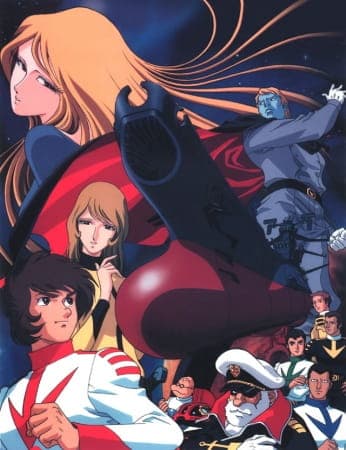
In the year 2199, Earth is a mere shell of its former glory after a vicious bombardment by the Gamilas Empire. The inhabitants have been forced underground to escape the irradiated surface, but the deadly radiation inches closer and closer to the retreating population. With only one year before complete and utter extermination, time is fast running out and hope is in short supply.
So far, any attempt to escape or retaliate has been instantly annihilated by the alien empire—until an emergency transmission from the planet Iscandar in a neighboring galaxy offers a glimmer of hope to save the doomed planet. Covertly, Earth's Self Defense Force constructs a faster than light engine for a journey to Iscandar. Armed with new weapons and a determined crew of fearless navy men, the World War II era battleship Yamato is reborn as Space Battleship Yamato. She and her crew set out on a perilous journey across the stars to save their home and the entire human race.
[Written by MAL Rewrite]
Nenhum episódio encontrado.
Comentários
Criffis
Well, this is my first review, so please go easy on me. I came to be interested in the anime, since I like naval-related stuff, therefore, the name Space Battleship Yamato made me think about the very well known Battleship Yamato, the Imperial Navy's pride during WW2. I did not know ANYTHING about the anime before deciding to watch it. Now I know about it's well renowned reputation as a pioneer in the science fiction genre. It was also one of the first (if not first!) anime being broadcasted in the US (with a LOT of modifications). Luckily, I watched the original Japanese version. Sohere is what I think of it:
Story:
The Journey to Iscandar? I really asked myself what that could mean before I watched the anime. Well, I am not going to ruin the story, so all I am going to say is that the plot is pretty convincing (although there were some mistakes and WTF moments that were mentioned at the credits after each episode, provided by the subtitle company). Earth in danger of extinction and the revival of a WW2 battleship to help her survive? I wanted to see that! The bla bla part and the good action scenes are very well balanced and the actual bla bla parts are actually pretty interesting and (sometimes!) heart moving. The ending, although a little bit too fast I would say, makes you want to watch more of the anime and (thank God) many movies and 2 other seasons were made for it. I give the story a well deserved 9.
Art:
I had (still have) watched few animes before this one, but the first thing that shocked me when I started to watch is the artwork. It is so different from what anime is today! I could not stop laughing about the funky-retro-70s pants that the crew used and the relative simplicity of the artwork in general. But oh well, this was just in the first episode. I got used to that. In fact, the way Queen Starsha was first presented, for example, gave her an aura of mystery, which really suits her. The most amazing thing though is the design of the Yamato and the battle effects. Although pretty simple at first sight, they are good enough to give you a feeling of YAY VIOLENCE, EXPLOSIONS PEW PEW, which (despite the fact that I wasn't even born in those days) could have been very difficult and innovative in those years (it was 1974 after all, no Star Wars, no Gundam Wing, no nothing!). The exterior and interior design of the Yamato is also very very interesting and creative. I give art also a 9.
Sound:
The sound... just one word: WOW. The opening already pumps you up and is already a good intro to the anime's epicness. The lyrics are perfectly suitable for the anime and we can't just forget the amazing voice of Isao Sasaki, an artist totally unknown to me before this anime. I watched many videos of him performing the Yamato theme (still today! he is almost 70 years old!) with the same enthusiasm everytime. I read that the opening theme became so popular, that it was informally taken as an anthem for the real Japanese Yamato. Anyways, back to the anime. The ending song (Makka na scarf) is as good as it's opening. Again, performed by Sasaki. Regarding the ambience music in the anime, it could not be better. They did a great job creating a space atmosphere around the Yamato. Battle themes, drama, happiness,... I really recommend to look for the whole Soundtrack CD. It is simply amazing! Sound deserves a perfect 10
Characters:
The ship cannot navigate itself, obviously. The Yamato's crew is as epic as it's ship. The swiss-clock-precise Shima, the rebellious Kodai, the intelligent Sanada... Every crew member shows a complete different personality and talents, which leads to a very rich environment in the bridge of the Yamato and also in the rest of the ship. Yuki is not the common tv show girl. She is the only one aboard the Yamato, but she is responsible for Life Support and also the Medical Bay (together with the funny doctor Sado). She is not the regular woman that falls in love instantaneously with the main character, but she evolves together with him to actually reach that point. Queen Starsha's mysterious personality and history is something that makes her very intersting, even atractive to some point (her beauty is very different to how anime women are presented today). She is obviously very important, since the Yamato actually travels to hear her advice. Lord Desler is also very different from today's villian. Although cruel, he is extremely intelligent. He also sees the Yamato with respect and holds to a certain point a clean fight with the ship. A very interesting character indeed. Last but not least, Captain Okita. Without a doubt, the most misterious character. Always calm and even more intelligent than Lord Desler, he is in charge of leading the Yamato and it's crew. His unorthodox methods scare sometimes scare Kodai or Shima, but his authority is never questionated. Will he succeed? Ok, character gets a 9 from me.
Enjoyment
From start to end, the anime made me laugh, be anxious, angry (Captain Okita's decisions and other stuff). I enjoyed every second of it. Whether Desler planned his strategy, the Yamato just blew everything up with the Wave Motion Gun or Analyzer teased Yuki, everything made the anime be watchable and worthy of my time. I did not toally like the ending though. Although it was good, it had a very WTF moment (which I shall not spoil) and I think the final parts were also a bit short. Anyways, enjoyment also gets a 9.
Overall
Retro anime, funky clothes, aliens attacking humanity, space battleships, guns and explosions? Hell yes! The anime, although it may look boring for today's anime fans, is still enjoyable and worth of watching. The depth of the story is also pretty astonishing, in my case at least. I recommend any sci fi or navy fan to watch this great time joy. I do strongly say you should watch the Japanese version, since the US one (known as Star Blazers) cut a lot of "inapropiate" scenes in that time (today, Space BB Yamato could be a good PG-13 as hardest measure, PG-7 I would say). The thing that makes me mad though is, that they renamed the Yamato as "Argo" which drops the epicness of the ship. Anyways, a must see!
(Note: English is not my native language. I'm sorry for any grammar / spelling errors).
ps1917
I first saw this series as a kid in the early 80s. It was branded in the U.S. as "Star Blazers" and I would wake up extra early on Saturday mornings to watch it. Along with (but vastly superior to) Battle of the Planets and Speed Racer it was my intro to anime and it sparked several lines of interest in my life that have continued to the present. It basically brings the outline from the Jason and the Argonauts myth and updates it into a very entertaining space drama. This is a classic series and as such the artwork, music, and characters are not nearlyas well polished as something more modern. But taken for what it is it was an astonishingly good work for the time period. The recent "Space Battleship Yamato 2199" is a completely updated re-make for those of you who can't get past the dated nature of the original. There was also a recent live action film that was so-so. The original series spawned many sequels which range from excellent to terrible.
If you like space opera and military anime you can't really go wrong with this series.
Ernacram
Space Battleship Yamato or : How I Learned to Stop Worrying and Love Warcrimes Story : 8/10 The story is quite simple and any person with a functioning brain should be able to follow it. I won’t go into detail as I don’t want to spoil and you can read the synopsis anyway, but basically the Yamato must travel across space to reach the planet Iskandar and bring back a machine that can purify the irradiated surface of the Earth. So in short, the battleship Yamato is renovated into a space battleship and has to save the earth from an alien civilization that seeks to exterminatehumanity. This is quite problematic since as told in the beginning of the series, the Yamato, largest battleship of its time, was the symbol of japanese pride and japanese military supremacy. The episode that shows how the battleship was sunk at the end of WW2 stinks of japanese nationalism. The Yamato and the fleet escorting it are shown as heroic and brave. When the ship sinks, you see japanese soldiers doing a military salute. Fortunately, this overly nationalistic atmosphere is only present in one episode, but I find it curious that the series doesn’t say anything bad about japanese imperialism, about the horrors and war crimes it committed all across East Asia.
In the beginning, the Gamilas are shown as an evil alien race, but as you progress throughout the series you learn that the situation is a bit more complicated than that : the Gamilas are pretty much the same as humans, and they are not trying to destroy humanity just because they are bad.
In each episode, the Yamato and its crew must overcome an obstacle, most of which are laid by the Gamilas empire, so a lot of episodes are space battles against the Gamilas space fleet or its military bases. I thought these episodes to be the most enjoyable to watch, as the space battle scenes are very well done.
In some episodes however, part of the crew must go to a planet (to fix a certain problem or just to investigate). Most of these episodes looked like filler episodes and were bad and boring to watch. Luckily, there are only a few of these, and most episodes are very good, if not excellent.
Art : 10/10
One of this series' strong point. Although the animation and art style may have aged quite a bit, it's pretty easy to get used to it. The scenes where you see the Yamato move around in space, along with the music, are wonderful. The design of the enemy spaceships and buildings are very cool, too. The character design are well done and the characters are easy to identify without them wearing extravagant clothes or having weird hairstyles.
Sound : 9/10
I don’t know anything about music so I can’t really describe it accurately but the soundtrack is one of my favorites and it goes very well with the battle scenes. The opening is unforgettable, one of the best I have ever seen. However some of the sound effects (mostly the laser fires) have not aged well.
Character : 9/10
Apart from Analyzer (who is also known as the sexual assaulter robot), the crew members are very human and likeable and you get to see their backstories in certain episodes. Most of the characters aren't too complex. You know what their motivations are and they are easy to understand, without being one-dimensional. The leader of the Gamilas empire, however, is too predictable. He’s just your typical cartoonish bad guy that wants the whole universe under his boot, always has an evil plan (that fails, of course), makes bad decisions, kills his own subordinates for fun and does an evil laugh for no reason. Luckily, the Gamilas empire does have at least one good character, Domel, a true man of honor that respects his enemy.
Enjoyment : 10/10
This series is very old and has many flaws, but it is a must watch for every anime fan. The wonderful animation and music give it a really high re-watch value. Definitely a show I will re-watch in the future.
Overall : 9/10
Glass-moon
Space battleship Yamato does not live up to it's reputation for me, however I see why people like it a lot. Story (5.5)- For the most part the story's your stereotypical humans vs. aliens story. Though there are times when it rises above that. You might think the Yamato's plot amour (which was done to conserve the anime's budget) would sink the show however for the most part it uses interesting tactics to get out of the sticky situations the Yamato is put in. The aliens also have a concrete reason as to why they are attacking Earth. Yamato has influenced countless si-fi titlesas shown by some interesting points occasionally like for example " Is it fair how the losers are treated ?", "Are the Gamilluans really that different form humans ?".
Characters (7.25)- Most of them are one note, however for the most part they are well written though. Kodai is a well developed character. Okita is the captain that supplies the interesting tactics that keep the Yamato's plot amour in check, and becomes a mentor for Kodai. Descular is the leader of Gamilon it's interesting to see his very authoritative aggressive personality sometimes create a paradox with his respect for the Yamato. Starsha could have been very interesting, however her character is not explored much. Mori was the worst character very little depth, and development, plus the bits of fan service.
Sound (7)- voice acting acting is good. The music is your standard 70's anime soundtrack.
Art (7) and Animation (8.5)- Animation is pretty impressive for the most part considering how old it is, though there are some odd facial expressions sometimes. The art looks fine.
Enjoyment (6.5)- The story occasionally is able to rise above, the characters are solid, good voice acting, and impressive animation and art for the time: made Yamato worth my time. Though it certainly has problems.
Overall (6.4)- The story is most of the time average, has a lot of bland characters, sometimes the Yamato plot armor is not kept in check, occasional animation mistakes, and the generic music hold it down. But the well written characters, and some standout characters, a story that occasionally becomes something more than usual, and impressive animation for its time: make it worth watching.
Spirit_Chaser
The story and impact of Space Battleship Yamato is one of the most inspiring and important events in the history of anime. When it first appeared in 1974, it shook the foundation of what TV manga could do. It would be the strong, innovative, and emotional writing of Yamato that would partly aid the medium towards gaining the name anime. It's cited as an inspiration for many valuable works such as Evangelion, Super Dimension Fortress Macross, and Mobile Suit gundam. Now that I think about it, Hideako Anno did quite a harvest on his influences. If you look at early mecha, there is a serieswith a character named Rei Asuka, for example. Another example: the song "Original Yamato Theme" was slightly recycled and used in Evangelion as the song "Background Music II."
There were already several science fiction works before Yamato, Still, the fleet battles, dramatic narration, and the strong structure of its story was bold and fresh at the time. Perhaps the viewers were not ready for an anime like this as it did not do so well at the start. Once the movies released, series creator Leiji Matsumoto, who would go on to do many famous works such as Galaxy Express 999 and Space Pirate Captain Harlock, noticed a large amount of fan mail coming from fans. This was especially among the women to his surprise. Director Noboru Ishiguro, who would go on to direct works such as Macross and Legend of the Galactic Heroes, explained that the sudden influx of fans resulted in many travelling, some by plane, to their studio during production. As a result, the staff would hang out animation cells and background pictures as a thank you.
The impact of Space Battle Yamato was so great that it inspired the creation of the game Space Invaders. The Yamato's Wave Motion Gun was also the inspiration for the Hadouken in Street Fighter. Not only that, it us rumored that it had an influence in the first Star Wars film that came out a few years later. George Lucas won't admit it despite that the similarities are there. Just one example is The Analyzer. It's the comedic robot that is rumored to have possibly been the inspiration for R2D2. This has been a topic of debate for decades that was reached no conclusion as many viewers are constantly agreeing and disagreeing.
Truly, if Yamamoto never existed, the many great works I mentioned earlier may never have existed, or been very different without it perhaps.
Being a work of Matsumoto, the master of melancholy, you can expect an emotional and dramatic space voyage as the Yamato ventures through space. The Gamilas led by Aberdt Desler is facing a dilemma. The life of their planet is running out. As a result, they decide to go out on a mission to take over the planet Earth. To destroy the humans, they sent out a barrage of meteor strikes that destroyed so much of human civilization that humanity had to go underground. Schools were being used as hospitals previously, and many of the women had to become nurses out of necessity. In addition to that, the Gamilas flooded the earth with radiation that threatens to seep into the earth to wipe out the last of humanity. In an attempt to save the human race, humanity has deployed an old World War II ship, the Space Battleship Yamato, to travel out towards Iscanda to acquire a machine that is capable of destroying the radiation poisoning that is slowly killing the planet and themselves. The crew only has a year to make the roundtrip, and faces many obstacles along the way through space anomalies and Galimus fleet battles.
The voice acting is immaculate. Among the main characters, Kodai is voiced by Kei Tomoyama, who would go on to voice Yang Wen-li 14 years later in Legend of the Galactic Heroes. Shima is voiced by Shuusei Nakamura, most famous for being the voice of Toru Rikiishi in Ashita no Joe.
The music I would say is iconic. There are lots of dramatic and amazing songs that help uplift the fleet battles and tragic moments. The funky drum work in some of the songs is impressive and amusing to see mixed with the scenes.
The art, for being a work from 1974, is impressive, even by today's standards. The beautiful hand drawn animation can fluidly and naturally present the brutality of the fleet battles. There is one episode that took the staff nearly 2 months to animate because of that. The character designs are solid, and there were many times interesting effects used to portray the murkiness of space and the emergence of the yamato from smoke.
As the crew continues their voyage, the stakes run high as their schedule starts falling behind. They have estimated one year's time before the radiation destroys the humans. At the end of an episode you may hear the narrator sounding desperate as he counts down the days until humanity's doom.
At this point I will start using spoilers for the analysis. I would highly recommend watching this historical document of an anime before continuing unless you don't mind spoilers.
In my opinion, though Kodai is the main character, my favorite is captain Juuzou Okita. He is the first captain of this new version of Yamato. His leadership is bold and provocative. His years of experience leads to unorthodox tactics to fight against the Gamilus or to get out of deadly situations. He knows full and well how to lead his team in a serious manner. He may sound cold, but he loves his crew, the earth, and the rest of humanity. The tragedy of Okita is that he is suffering from radiation poisoning. As the Yamato went on, he'd often collapse from it. The doctor, who is usually seen drunk drinking sake, tells him that he needs to get an operation to stay alive. In Okita's point of view, he is determined to follow along with his duty to lead the crew. However, even I would say that if he doesn't get the operation, it will get in the way of his focus during crucial moments. And this would be the case as he was constantly passing out while on duty. Eventually, he decides to get the operation, and is left mostly bedridden. A wise man, he spoke some words that really inspired me. There was a time where the crew of the Yamato had doubts about their journey. Hope felt as it was lost. And yet, Okita would confront them and state, "Why don't we believe in ourselves? Nothing is sure in life. One step ahead is darkness in our lives, but if you're overly afraid, you won't accomplish anything. Overcoming our fears, and believing in our future is an important battle in our minds." Always calm cool and collected, he always kept his composure even during the most dire situations. Even after being defeated at some point by the Galimus, he respected their strategy in defeating him. Oftentimes, his reactions would be quiet as he'd sometimes look down with his hat, covering his eyes, or look straight ahead with an unshakable determination. Despite there being no dialogue, his reactions feel like they speak louder than words at times.
Since the beginning, he felt for the loss of Kodai's brother who supposedly died in the beginning of the series fighting the Galimus. Shima would express regret towards Kodai as an engineer that Kodai's brother had entered this mission on a ship that Shima knew was too damaged for the mission. Considering all this, Okita developed a bit of a soft spot for Kodai. As his time grew near, Okita would summon Kodai and make him the new captain of the Yamato. Determined with the will to live, as the Yamato makes its trip back to earth, Okita kept himself alive with solid resolve that he must see the earth again before perishing from the radiation. It would be around this time that he began thinking about the concept of death. He was under the assumption that the soul leaves the body when someone dies, and looked on out into space while bedridden wondering where his soul will go after he dies.
The most crushing moment in Space Battleship Yamato is his death in the last episode. I was in tears constantly as the writing pushed the blade deeper and deeper into my heart. There were more tragic events that were already giving me heavy emotions in that episode already. As obvious as the obvious demands for the sake of the plot, the Yamato does make the roundtrip which I'll look into later in this video. Okita thanks the doctor for his treatment and asks to be left alone. As the emotionally tragic music plays in the background, Okita takes out a picture of his family and caresses it with his hands. His hand then begins to shake as he tears up. He looks up at the Earth and speaks weakly with his dying breath, "Earth. Everything about it is precious." He passes on, leaving behind part of the environmental message that the series tries to make about the planet we live in. As he met his end, there is a miracle that happens here that I will explain concerning him and Yuki when I get to her. It's only a theory but fairly interesting.
Kodai, is another protagonist and the successor as captain of the Yamato after Okita personally handpicks him. He suffers from the trauma he faced as a child from the attacks of the Galimus. His parents were obliterated in a meteor attack. Kodai finds only scraps of their clothes. Later on, he had to go through the supposed death of his brother at the hands of the enemy. Though he grew up as a pacifist, he decided to volunteer for the army partly due to his brother's wishes for him to do so. It is this trauma that leads to that intense moment where the Yamato crew managed to capture a low ranking soldier from the Galimus. At that point, humans did not know what they looked like. Once the doctor reveals the blue man's face, Kodai became infuriated. How could a race of aliens so cruel and brutal look like a human? He cannot accept this and tried to stab the alien with a tool. The crew members stop him, and as Kodai begins to gather his cool. The captured enemy soldier then decides to try and take his own life at the point, and gets immediately and ironically saved by Kodai right after. To show that the Yamato crew are not the type to torture, they feed the soldier and eventually let him fly back to Galimus after failing to get intel out of him.
Throughout the series, there is the obvious romance that builds up between Kodai and Yuki. Yuki already had a crush on Kodai and would tease the oblivious soldier about it constantly. She is a chief member of the crew, and is often seen handing drinks out to them, performing her tasks during missions, or finding herself victimized the Analyzer. She is main woman protagonist, and for an anime as far back as 1974, has a beautiful character design. Her personality can be very playful, yet behind the scenes she is depressed about being separated from her family. There are a few points where the crew are allowed to communicate with earth during their trip. The entire crew are allowed 5 minutes to talk to family, and you can see the desperation of the people on Earth during this time as well as the emotional breakdowns of the crew who miss family and home. When Yuki calls her parents, she sees that her mother has become obsessed with her getting married with having lots of kids for the sake of the continuation of humanity. This leads to poor communication as their time ran out talking about trivial things.
She gets involved in an odd triangle eventually between her, Kodai, and the Analyzer. The Analyzer is a hilarious robot aboard the Yamato that performs date collecting among other tasks. He believes he is a human despite being man made and not God made, and is completely in love with Yuki. Outrageously, he often flirts with Yuki, or tries to undress her during inappropriate times. Yuki eventually goes to complain about the Analyzer's predatory ways to captain Okita, though nothing could be done to reprogram him.
episode 16 would be the episode where she and The analyzer would come to a resolve. Of course, Yuki tells the robot that she could never be with him because of what he is. The Analyzer disagrees and says that he feels he is human enough to love her. They would eventually get captured while scouting in an unknown land by an alien race because Yuki for whatever reason want to climb into a strange hole that led to their nest. As Yuki talked about the fear of her own death, she accidentally insulted the Analyzer by saying that is he died he'd just become a pile of scrap metal. The Analyzer argues frustratingly so that his life is not worth any less to that of a human just because he is a robot. After making up, he decides to do all he can here to protect her, and even Yuki at some point acknowledges that he has a human heart despite being nuts and bolts, and hugs him.
One part of the emotional side of Space Battleship Yamato is that when the characters hug or caress each other, there is a lot of emphasis on this that shows how precious they all mean to each other.
Eventually, they are taken out for execution by the insect race. The Galimus, which were controlling these huge insects appear, send in a ship but their crew get killed. A part of the insects were rebelling and stated that the queen is using them for their blood to give to the Galimus. This is true. If any were to rebel, they'd get crushed and processed into goo. As the civil war goes on, the Yamato crew would come to save her. Though the Analyzer felt closer to Yuki then ever before as they were embraced during the war and rescue mission, she would run from him and go to Kodai, hugging him instead. The Analyzer felt depressed, and decided in that moment that maybe he really is just a robot after all. At the end, Yuki confronts him, and reminds the robot that they could never work. The Analyzer responds that he'll always love her. As be rolls away, he asks her, "There's nothing wrong with loving someone, right?" Creepy behavior aside, The Analyst is the funniest character in the series and best source of comedy in general with how outrageous he is. He can be often found getting drunk with the doctor by pouring sake over his metallic head.
Something I started thinking about half way into this series is the mental effect of being stuck out in space for hundreds of days. The series does address this later as some of the crew begin to lose their minds from being out in space away from their families for too long. One crew member named Aihara would take this to an extreme. Though a Galimus plot, Aihara was manipulated into missing his family so much that he loses his composure in front of the crew and jumps out of the ship in a suit into space. Eventually, he realizes the wrong in his ways and luckily gets rescued as he would have died out in space. What is also interesting about this is that the Yamato has an image therapy room. Those who get anxiety are placed there and are given illusions to make them feel as if they are at home or somewhere out in the wild. In Aihara's case, he recognized this as fake. As a result, it didn't help him and eventually led to where I said he desperately tried to swim back home from space which was impossible.
It is around this time that Kodai himself starts to lose it somewhat. He and Shima, who helps with navigation, often get into arguments and fights here. During one emergency situation, Kodai demands that he follow him. Kodai then expresses his desire to beat him while Shima expresses his desire to toss Kodai out into space. It's amusing to watch Until Yuki stops them. Still, they become comrades until the end of the series. Shima himself lost his sister in an accident from a ride at an amusement park and he himself ends up with four cybernetic limbs as a result. He nearly dies during the end but shows the necessity of sacrifice after he blows up a Gamilus ship by detaching his limbs that had bombs installed in them.
Next, I want to talk about the Galimus. They are the main antagonists of the series and are led by Desler. Desler is a smug and ruthless ruler that doesn't hesitate in killing his own men, even high ranking ones, for slightly annoying him or to just make a point. His goal is to take over planet earth seeing as though their own homeland is collapsing and dying. He becomes interested in the Yamato and decides to destroy it. Time and time again, the Yamato manages to overcome his admirals and dirty tactics. Still, for Desler, he finds amusement and excitement over this. Often times he'll laugh with fascination at how strong the Yamato and how intelligent it's crew is. It almost feels as if the Yamato itself is what gives him a reason to live or feel excitement in life. Regardless, he tries relentlessly to try and destroy it.
Desler ends up ordering Admiral Domel to the task. Domel ends up replacing Gale, which outrageous him. Gale was proud of his position, and could not stand Domel to the point that he would start sabotaging Domel when trying to destroy the Yamato. There was a point where Domel had assured victory. On the other hand, Gale went to Desler and told him that Domel was trying to sacrifice one of their bases to destroy the Yamato. Domel was, however, and had to let the Yamato survive the one time he could have destroyed it since Gale was jealous and spiteful of him. At the same time, Domel often had fun teasing and making fun of Gale, such as when he went into Gale's residence and tossed around his fine china telling Gale he has bad taste. Even when Gale tried to light Domel's cigarettes with a faulty lighter, Domel used the opportunity to compare Gale's lighter to how incompetent Gale is. As a result, Gale would often show frustration and throw drunk temper tantrums at his residence.
Near the end of the series, Domel loses his fleet and decides to self destruct their ship on the Yamato as a last ditch effort. As much as they were enemies, Both Admiral Domer and Captain Okita recognized and respected the great level of skill they both have for combat. Domel would perish in the self detonation along with a panicked Gale. Regardless, the Yamato survived. Truly, they are both fighting for the same reasons. Galimus is just trying to survive by fighting for a new home planet for their people, while the Yamato crew are fighting them to save their own kind and planet. At one point, the vice president of the Galimus pleads with Desler to try to co-exist with the humans, but Desler disagrees and shoots him to death.
An interesting small detail about Admiral Domel is that he decides to keep a rare bird he found at some point. It reminds me of the bird Captain Harlock has which ends up being paid homage to in Cowboy Bebop with Vicious's bird.
In approaching the end of the series, it is revealed that Kudai's brother was still alive the entire time. He had been saved by Starsha, the queen of Iscandor that the Yamato were travelling to to meet for the purification device. Kudai and the crew felt relieved to see him still alive, but Starsha had fallen in love with him. She tells the brother this and runs away right before the Yamato took off. Kudai's brother, though finally reunited with his brother, apologizes to him and runs back to stay with Starsha in Iscandor. Kudai was fortunately accepting of this, and told Yuki that they have become the Adam and Eve of Iscandor. He is right in that the two would go on to rebuilt civilization as it seemed.
Before going back home, some of the crew lost faith in the last part of the mission to make the delayed trip back to earth with the purifier. It was led by a crew member named Yabu, who had kidnapped Yuki during that episode. They went to go take over an ice castle, but fell to an environmental disaster. Their goal was to repopulate humanity there and take over the planet as they saw the earth as a lost cause. Yuki was saved, at least.
In the finale episode, the Yamato makes it back, but not before Desler reveals that he survived their last battle, and makes a last ditch effort to destroy them with a large drill. At first, the Galimus board on to the Yamato, and inject radioactive gas into it to kill many of the members. Yuki would activate the purification device to counter, but seemingly perish from the gas during her attempt. The device activates, and the Galimus flee. Desler then has the Yamato impaled by a giant drill. The Yamato is able to hijack the drill bomb with the help of The Analyzer and sent it back to him, blowing him up. Still, you can see Desler vanish before the explosion revealing that he is still probably alive. Kodai, in complete disbelief that Yuki has died, goes to see her body and decides to carry her to the control room so that she may see their arrival to earth. He makes a love confession that he loved her since the beginning. He was waiting until the mission was over to confess, but cries with her in her arms seeing as though it's impossile now. As the Yamato sees Earth in its vision, this is where the miracle theory comes into play. Immediately after Okita dies, Yuki comes back to life. Perhaps it's about when they were talking about where souls go after they die. Maybe Okita's soul revived Yuki. Still, that's just a guess. The Yamato makes it back home within the long time limit, and the earth appears to be saved. The story concludes leaving the viewers with heavy hearts for the price it took for victory.
If I was to point out the flaws in this, there are a few. Sometimes the filter used to portray the murkiness of space stays in place inside the Yamato. Yuki reviving may not make much sense to some viewers because it isn't outright explained. Something that kind of bothered me is that the Yamato takes much more punishment than it should. It gets constantly blown up, rammed into, melted, and severely damaged. Regardless, the crew always seem to have the resources to repair whatever happens to it. It felt a bit too convenient at times.
Despite this, Space Battleship Yamato has secured itself in my favorites list as an important part of anime history and as an essential viewing. The spirit of Yamato would live on through macross, Orguss, Legend of the Galactic Heroes and in all the other space operas that carry the torch.
BowlingJD
Written by Leiji Matsumoto, I was super excited to watch this. Known as Star Blazers in America, its debut was in 1979 and the broadcast consisted of Yamato with its' two sequels. It wasn't until I re-watched the original Mobile Suit Gundam for the x-th time and wanted more space opera-type shows that I discovered Matsumoto's work. However, until now I had only watched his shows in scattered episodes never fully completing any of his shows. Coming out in 1974, the art is very impressive compared to previous anime with minor hiccups occasionally cropping up. The music is pretty epic like that of old Soviet hymns,and consistent throughout the show from point A-B. And, who can say that bellbottom space pants are a bad thing?
Story wise, many have probably already seen the "Humanoid alien race attack Earth" plot line. However, there is for once, a clear-cut reason behind the alien attack, why there are mostly "kids" doing the fighting, and why the aliens (Gamilons) do what they do throughout the anime.
When it came to characters, no, they aren't too impressive, and are fairly one dimensional with little to no character development. That being said, it really doesn't matter. The main character doesn't really feel like the main focus. It's the journey and trials the Yamato must make to save Earth. "You" do see Kodai (MC) evolve as a human, the evil alien Desler be James Bond villian 101, Captain Okita be calm cool courageous savior of everything, and the best robot (Analyzer) I have ever seen in an anime in a long time.
As much as I enjoyed this, during the end of development, the staff had two projects going on at time. This made the animation staff crunch for the deadline, and made the ending extremely rushed. Very sad for almost a perfect space opera anime.
As a biased fan of mecha and space operas, this was an almost perfect show. I am definitely going to watch more Yamato anime.
MS1988
I saw something about the show and the premise, and it was just too absurd but also too creative to not check it out. As a Gundam fan, I can clearly see the inspiration Gundam received from this series. I was quite hooked from the beginning, and the show does a good job of showing you the stakes by repeatedly looming the countdown to Earth's total destruction at the end of each episode. I never felt like the pacing was lagging or that we were just spending unnecessary amounts of time in one place after another; everything moves at a quick speed. My biggest complaint isthat it takes a little while for the characters personalities to shine through. Near the beginning, I felt like Kodai and Shima were pretty much blank slates with one-dimensional personalities, and their places could be swapped with each other with little difference. Luckily, around episode 7, we start to get a lot more characterization for both of them that sets them apart as distinct. Another thing is that it becomes apparent that the Yamato has pretty strong plot armor and can take major beatings that even the supposedly superior Gamilus can't withstand. Also, the Yamato is miraculously repaired on many occasions in the next episode after sustaining horrible damage. I guess this can mostly be attributed to reusing animation, so it's excusable to me.
If you like old-school space operas, you'll like this. If you're less used to older anime, it may feel dated and clunky to watch with its many animation errors and rough line art; however, if that doesn't bother you, I'd say go for it.
mouthpiece
Notice: This review covers all seasons and movies of the franchise. Reading it is like reading about all of them. Battleship Yamato (known as Star Blazers in the American dub) is an early work of Leiji Matsumoto and the first example of what a good animated series can be all about. As basic and silly as it may seem today, this series happened to be amongst the most mature titles of its era and opened the way for others to pick up the style and work on it. Anime back then were really childish and crude but this one tried its best to be serious withscientific explanations trying to reason all the weird technology in the series; even the means the animators used were top notch at that time. Thus you need to have an open mind if you want to properly enjoy it for what it is or you may find yourselves asking stupid questions such as how can you enjoy the first Star Trek series when the later ones have better visuals.
ART SECTION: 7/10
Analysis: General Artwork 2/2, Character Figures 1/2, Backgrounds 2/2, Animation 1/2, Visual Effects 1/2
The setting is a space adventure regarding journeys to alien planets, plus lots of repetitive mass destruction scenes of fleets and Earth. The animation begins very poorly to today’s standards; inconsistent proportions, plain colors, crude movements and a dozen follow-up scene mistakes per episode will make most young viewers to laugh at it. Still, reading the story behind the scenes I can simply salute them for coming up with such nice tricks to create new ways of expression while experimenting with special effects. They were practically given a tight budget and just a week to create an episode to be aimed at a few hundred children and perhaps their parents. For such crummy rewards, they did wonders. The production values are also slowly improving with each new installation; giving more details to ships and less body deformities. Just like the Star Trek franchise, they build on the main idea along the way and further flavor the presentation.
SOUND SECTION: 7/10
Analysis: Voice Acting 2/3, Music Themes 3/4, Sound Effects 2/3
The voices have a spark in them half the time but are usually too heavy on idealism and they may sound ridiculous to the more modern audience who didn’t grow up in warring times. The dialogues can be extremely irritating since the good guys keep shoveling us with awfully idealistic monologues about hope, justice, humanity and a load of other crap no sane viewer can stand for long. The bad guys keep talking about how reassured of their great forces they are when in practice, they never win a battle. Give us a break you guys! I guess it felt cooler than corny back then, just like Star Wars felt more serious and awesome a few decades ago. Times do change…
In a similar way, the music themes are laughable for their over the top melodramatic feeling. The main song is remade a bit better in the next seasons, but the lyrics don't match with the goal of the story. They are no longer going to Iscandar! They are otherwise nice sounding ballads that fit the whole feeling of the show.
STORY SECTION: 5/10
Analysis: Premise 1/2, Pacing 1/2, Complexity 1/2, Plausibility 1/2, Conclusion 1/2
The first season was made in 1974, and the story was about aliens who attack the Earth with radioactive comets during 2199. The Earth fleet goes to the offence by recreating its ancient flagship, this time as a super powerful spaceship. Its mission is to stop the bombardment and find a radiation cleaner device within one year, offered by a mysterious woman in a far away planet.
It is a very clichéd story and you most likely have already seen a billion series with a similar premise. It even ends in a predictably melo way; which is what the people back then expected instead of surprises. Each episode is a scene about what the good guys do in the ship, a scene about what the bad guys scheme, and then we get a battle between them. Which is not that different than what is going on in a typical mecha show.
The story is also nothing more than a fairy tale version of the Second World War. The alien invaders are the Americans, the radioactive comets are the atomic bombs, the Humans are the (kind?) Japanese people and the Yamato is their famous battleship (and symbolically their pride) that rose to take revenge and save their lands from foreign oppression. And what a surprise! The humans/Japanese people always seem to be right and win in all the battles! As for that alien woman with the radioactive cleaner device, she is an excuse to have a happy ending in our story. If only reality was that kind …
But as I said, back then it felt far more realistic and serious that the stuff that preceded it and it was technically made to cheer up the post-war Japanese people. Heck, some can argue that most stories of modern anime are still not as serious as Yamato’s space opera genre, where you get a lot of character interaction and world building. There are even some interesting revelations towards the last episodes that make the otherwise generic story a bit interesting and unpredictable. For the first time the villains show a few emotions and they don’t plan to just take over the universe but simply to immigrate to Earth because their planet is dying. Makes it good next to, let’s say, the dinosaurs in Getter Robo who despite being in a similar situation they were never allowed to be anything other than cardboards without the slightest colorization or drama.
In terms of realism, the series tries to be intelligent since the Yamato is made after a real battleship and every planet it goes to is followed by a simple narration of how the climate is all about there (based on what they knew about the universe, back in the 70’s). Also, every special weapon both sides use has a simple explanation of how it works. In terms of plausibility though, the series sucks since there is no way a single spaceship can survive a hundred thousand bombardments and still win in every battle against millions of advanced spaceships without having a reassured way of repairing damages and reloading weapons after each battle. The good guys never seem to die or lose, no matter the odds. And damn, humanity appears to be getting almost wiped out every year yet miraculously manages to rebuild and flourish with the speed of light.
So far I mentioned only stuff that happen in the first season. What about the rest of the installments?
The second season (aka The Comet Empire) was made in 1978, and the story is about aliens attacking the Earth with a huge comet fortress. The Yamato takes a mission to find a mysterious woman in a far away planet that possesses the power to stop them. If you paid attention before, you will realize that IT IS THE SAME STORY ALL OVER AGAIN! Yeah, originality went for a walk but nobody minded back then. Still, the story is better than in the first season since humans and aliens have now internal conflicts around authority and honor, making the plot a bit more perplexing and unpredictable. Also, the battles are far more grand-scaled and less straight-forward. The same year they also made “In the name of Love”, a movie-retelling of this season, made up of the best scenes of the series, boosted with a lot more drama and death. The story is altered in a way to be a lot more straight-forward but also a lot more dramatic. All characters talk with a lot more passion (which is a plus) and almost all of them die (they survived in the canon story).
The third installment is actually two movies, “The New Voyage” in 1979 and it sequel “Be Forever Yamato” in 1980. The evil Desler starts feeling remorse for all he has done and even asks of the Yamato to help, after he finds out that his twin planets are being mined to death by the Black Nebula empire. Kodai, now captain of the Yamato, doesn’t think twice to return to planet Iscandar, as Mamoru, his brother, chose to stay there with Starsha on season one. Things start to get very grey and violent from here on as the dreaded high death count is back. Later on the Black Nebula invades Earth and conquers it rather easy, thanks to the Hyperion bomb than kills brain cells on a planetary scale. Kodai gathers the Yamato crew for yet another rescue-the-Earth mission. This is by far the best part of the whole Yamato franchise ever made; it has so many scenario developments and emotional moments than all of the previous movies and seasons put together. A few of them are the following: (do not read if you don’t want spoilers) Yuki is taken hostage and seduced by the enemy, Mamoru sacrifices, his daughter Sasha becomes an adult in only a year and digs her uncle Kodai, the Yamato is seemingly sent to the future and witnesses its death, and more and more… Man, it was a blast! A thing I didn’t like here that is kept as an annoyance even in later instalments is how every new opponent seems to appear out of thin air. There is no foreshadowing to excuse them being there before their introduction. Where was Black Nebula hiding all this time? What was it doing during the previous seasons? … Ok I am overthinking this.
The fourth installment is the third season (aka The Bolar Wars), made in 1980. Yet another empire that came out of nowhere is in the middle of a civil interstellar war. One of its planet-destroying missiles hits by accident the sun in our solar system, which will cause the sun to turn super nova in a year. The Yamato takes another mission to find a second Earth so that humanity can survive by migrating there, learn of what is going on with the war, and find a mysterious woman in a far away planet that possesses godly powers. Once again, you will realize that IT IS THE SAME STORY FOR THE THIRD TIME! Didn’t the scriptwriters get paid to write them? But yet again, the plot is even better; the aliens have their reasons for being good or bad and not all of them are thinking the same way. Also, the battles are even more grand-scaled and less linear.
The fifth instalment is another movie, “Final Yamato” made in 1983. Our galaxy collides with another galaxy and causes intergalactic havoc. Planet Aquarius, which gave life on Earth countless years ago, is causing floods and a dying civilization intends to warp the planet to Earth and inhabit it after all its people have drowned. On the good side, the scenario is based on the Panspermia theory and on ancient Babylonian myths about the arrival of aliens and the creation of life in ancient times. For once, all those weird cosmic phenomena and humanoid aliens throughout the universe have a reasonable explanation. On the bad side, the scenario is a chaotic pile of incoherent ideas and forced events. Nothing makes sense, given the length of the movie. What’s with the galactic collision? Why do the aliens need to warp an entire planet when they could easily conquer Earth with conventional ways? The only survivor of a dying planet was conveniently the prince of the aliens? Desler only appears in the nick of time? A goddess that causes us harm out of love? OKITA IS STILL ALIVE ???!!! People come and go, appear and disappear, live and die so fast that you don’t feel a thing about them.
The sixth installment was made many years ago, part of preparing the rebooting the franchise. Resurrection (made in 2009) finds our galaxy being slowly eaten away by a sentient black hole. Humanity tries to immigrate to another far away planet before it is too late but encounters the hostility of an alliance of alien cultures, who are made to believe humans are invaders. The Yamato is remade as part of yet another rescue mission, to stop the attacks on the transport ships and to find out why they are all so hostile towards them. There was enough mean to create a nice full season out of this but unfortunately they just rushed through everything and thus the overall feeling feels lazy and undeveloped. There is a sort of revelation towards the end regarding the mystery of the black hole but it just came out of nowhere and there wasn’t proper build up to care about anything.
In all, the story began in a very simple and corny way, gradually improved through the three seasons, reached a great height in Be Forever Yamato, and simply lost its passion to keep trying to be good. So I am kinda worried if they will even care to make a worthy reboot in 2012.
CHARACTER SECTION: 5/10
Analysis: Presence 1/2, Personality 1/2, Backdrop 1/2, Development 1/2, Catharsis 1/2
Well, compared to today… they plain suck! They are all character archetypes, without personality coloring by today’s standards. The description below can pretty much count in all the seasons and movies of the series.
- Human males are the epitome of yasashi (kind hearted) Japanese people. You know, always kind, gentle, strong-willed… and with a permanent dorky expression on their face.
- Human women are… just there. Frail, kind, beautiful, always in love with the main characters. Generally, they are very few in numbers, have very undermined posts and have very minor roles. They hardly count as fan service or emotional support. Heck, at some point they even disappear from the ship’s crew entirely.
- Alien males are just… blue-skinned humans. Seriously, they even share the same DNA as humans. Couldn’t the animators make them more exotic or something? And as far as personality goes, they behave just like megalomaniac, imperialistic, military people. They have German names and salute like Nazis. You can imagine on which people they were based upon.
- Alien women are the Deus ex Machina solution in the story. There is always a beautiful alien babe in some far away planet that is bent on aiding Earth with an ultra powerful way.
As far as interesting characters go:
- The good guys are completely boring. Weak presence, no personality, no development, not much background story and no catharsis since they were already perfect people without any worries other than saving Earth.
- The alien leader Desler is interesting for being a paranoid megalomaniac. He even matures a lot in the following seasons. Hooray for the villains!
- And there is also Analyzer, a comic relief robot that seems to do all the work that the dorky heroes are too stupid to do themselves. Plus, it makes a lot of sexual teasing. How I wish there were more characters like Analyzer; it is a robot and yet acts more like a human than the stale and picture-perfect “robotic” humans he aids.
Again, I am sure the cast felt far more creditable back then exactly because it felt so ideal. Those times were far more black and white than they are today. But surely, for a genre that allows the director to colorize and develop its cast along the way, they don’t feel like much. They do become more colorful in later installments but never enough to be deemed very interesting.
VALUE SECTION: 5/10
Historical Value 3/3: A cult title for all the above reasons I mention.
Rewatchability 1/3: Maybe just for the battles. There is no much of a story or characters to bother with.
Memorability 1/4: A very generic series you need to remember for historical reasons and not for the cast or the story.
ENJOYMENT SECTION: 5/10
A very generic story, with a very generic plot and a very generic cast makes most of the series a very boring watch.
On the good side, the series is full of good sci-fi ideas that prevent the story from becoming a typical “brainless invaders vs idealistic humans.” For instance, the aliens use radioactive meteors from a base on Pluto, instead of sending their army there. It makes it far more original and realistic this way. They possess reflective satellites than make their laser beams to bounce around planets. They even possess tractor beams and teleportation waves that sent enemy ships on corroding seas of acid. The Yamato has light-speed technology, wave particle engines and cannons, magnetic shield ring and laser reflection coating, all provided with a simple explanation. This parade of basic strategies and special powers makes every battle far more interesting than, lets say, most mecha series where all they do is throw energy beams at each other. And yes, I do know it caused millions of people to shed tears but I still find it very weak if I compare it by today’s standards. It may still beat most modern anime in tragedy but it simply presents things very superficially and melodramatic to the point you prefer the formula as it was in less serious mecha shows because the lack of realism was excusing stuff better.
The second season has better animation, more perplexing story, and a bit more colorful characters making it a bit more enjoyable. And not to forget to mention the new weaponry. The aliens have more terrifying weapons than the previous ones, making them far more sinister. They possess a planet-destroyer comet, moon-destroyer missiles, teleportation beams, laser reflection barriers and can even resurrect the dead! You don’t find such variety in most series.
I personally consider the retelling of “In the name of Love” to be sappy. It was made just to give a quick and dramatic ending to an otherwise ongoing series. There are many interesting events in the series that you will miss if you don’t watch it. So, I recommend to watch this movie if you found the second season to be terribly old and uninteresting. It is a fine conclusion for all of you who don’t intend to watch the third season.
The New Voyage and Be Forever Yamato are full of space battles, and dramatic dialogues. They have a very fast pace and are quite enjoyable if you are a retro freak.
The third season has even better animation, even more perplexing story, and far more colorful characters. And guess what; we get even more terrifying new weaponry. The aliens are even more sinister than the ones in the second season. They possess planet-destroyer missiles, subspace submarines and black hole bombs! You don’t find such variety in most series.
“Final Yamato” and “Resurrection” are by far the most childish parts of the Yamato franchise. They have many good scenario ideas and yet they are all wasted by terrible presentation and Deus ex Machina situations. Enough with the corny “I love you” routine between Kodai and Yuki. It got boring after the 1.000th time! And enough about the destruction of the Earth every 6 months! And of the Yamato mysteriously surviving a hundred hits when all other ships blow up with a single strike. And the ending! How terribly melo it was! At least there were several well-made space battles that war-otakus will love.
VERDICT: 5.5
The forefather of anime space operas. He is really old and senile but it is he that all the rest look upon for ideas. If only the tv series was as fast paced and action based as the movies, it would still be a title most otakus would keep around. But seriously, for those of you who were waiting for a good conclusion to a cult title in Kanketsu hen, this is far from satisfying.
SUGGESTION LIST
Uchuu Kuubo Blue Noah. Another series with a ship bent on saving Earth from aliens.
The Captain Harlock saga, the Ginga Tetsudou 999 saga, Shin Taketori Monogatari: 1000-nen Joou, Arcadia of my youth & The Galaxy Railways. Famous series, made by the same cartoonist, Leiji Matsumoto. You will notice that his characters are identical in all his works.
The first Star Trek & Dr. Who seasons. Cult sci-fi series. They pretty much have the same retro appeal.
Macross. A semi-serious mecha series and semi-space opera with a similar story.
Banner of the Stars. An intergalactic romance / war that transcends species.
The Legend of the Galactic Heroes. The epitome of space operas.
AnimeTopScholar
Space Battleship Yamato, otherwise known as Star Blazers: The Quest for Iscandar is based on the work of Leiji Matsumoto and was directed by Noboru Ishiguro. This show from 1974 is by some concidered the inferior version of Yamato, with the remake 2199 being hailed as the better version. Is that really true though? The story of Yamato goes something like this. In the year 2199 the earth is under attack from aliens known as Gamilas. Humanity has been forced underground to escape the irradiated surface, but the deadly radiation is seeping underground and humanity will be destroyed within a year. Earth recieves a transmission froma planet called Iscandar, who claims to have a device that can get rid of the deadly radiation on earth. However they have to travel 148000 light years from Earth to get to Iscandar. Thus humanity sets out in the spaceship Yamato on a desperate attempt at saving the earth.
The first thing I noticed with this show was that for being made in 1974 it looks really good. Very few of the production hiccups you might expect from anime at this time was present in this show. The animation was decent and even though I found myself saying things like "the effects animation looks kinda weak", I was comparing that to modern day digital effects works. So I honestly have to give this show huge marks for having such a healthy production.
To answer my earlier question, is Yamato (1974) a weaker show than Yamato 2199 (2012)? Honestly, I would have to say no. If anything I would say that despite adapting the same story they are very different. They are two completely different takes on the same story. The original Yamato focused on humanity's struggle to avoid going extinct, their travel to Iscandar and the dangers that comes, and 2199 seemed to focus more the crew aboard the Yamato and how they grew closer over the journey to Iscandar, as well as splits and conflicts between the crew members. Now, I will say that personally I enjoyed 2199 slightly more. It tied up some loose ends in the original and was overall just a good show, but that does not take anything away from the original. It was a solid show all the way through, and apart from a few things at the end that seemed to happen mostly for convinience or were left unexplained, it was a good show that I would recommend everyone to watch. And even if you for some reason don't want to watch the original, I still highly recommend the remake 2199.
SCLFI
Space Battleship Yamato. Not something I would consider ordinary, nor was my encounter with the show exactly ordinary either. While looking up IJN ships on Wikipedia, I moved to an article about the Yamato Museum, a Japanese war museum that didn't stand out to me much, apart from one thing, and that was that it screened this show, which I'd never heard of. The IJN Yamato is refitted to become a spaceship, and has to travel across the galaxy to obtain a 'Cosmo Cleaner' to save the world from pollution. Well, that's such an absurd set-up that I had no choice but to watch it.But from all that, I gathered it was some sort of parody of space opera - a Japanese Spaceballs, if you will. But not only was it not a parody, it actually pre-dated Star Wars, perhaps the biggest sci-fi franchise of all time, as well as out-grossed it in Japan. But I've digressed, too long, onto the actual review now.
As previously stated, the story is about the IJN Yamato fighting against aliens to save the Earth. Personally, I do think that with the premise (I still don't get why they chose the Yamato, was the author the son of one of the main ship's engineers or something?), and for the most part, there really isn't a huge amount of intricate details in there, it's mostly just the Yamato flying through space to get to the (fictional) planet Iscandar, and each episode avoiding obstacles put before them. One thing I can praise the show for was that it did show us their motivations (i.e. they need to capitulate Earth to survive themselves), but I think if they were going to go ahead and do this, then they should've really toned down all the "we are evil and going to destroy Earth because we are evil and very bad and like slavery" in all the episodes prior. At the end of the day, the story is a solid premise, executed well, and each episode brings about new and interesting developments.
I am a modern viewer, watching this in the late 2010's, and so I've gotten very used to the animation quality of this decade and the previous one, so naturally, a show from 1974 will seem of lesser quality in this regard. Still, as long as it's not actually painful to see, it really won't affect my viewing experience, and while I wouldn't go that far, the animation quality isn't that great. The lip syncing is off quite a bit, people have walk cycles like N64 games, and on the whole everything does look a bit stiff, but it's not terrible, it's not so bad it detracts from the experience, and the physical design of the characters, weapons, environments, etc. are all done with a clear sense of creativity, and I'd say this more than makes up for it.
Generally, I'd describe the sound design to be rather similar to the animation. The music is of an acceptable standard, though it is interesting to note that both the usage of classical music and a leitmotif that sees frequent usage with several renditions. Beyond that, the voice acting and SFX are all just passable. Not much to write home about.
The characters of Yamato are quite well presented, each with their own values, behaviours, and, well, character. Perhaps some viewers will find them lackluster in comparison to later titles such as Evangelion or Cowboy Bebop, but at the end of the day, they all stand on their own. Even the drunken doctor, who's really just there for the sake of humour, even he is a character you enjoy the presence of, there is nobody in the show you wish the author just never conceptualised.
A shame I can't give a powerful and explosive conclusion like the real-life IJN, but I suppose there is no need to. Yamato is a quality sci-fi, and it has my seal of approval. It may be lagging behind other, more recent titles in some aspects, but it's no Metropolis, and any fan of sci-fi, or just military and action in general will not be disappointed.
Dotanuki
Yamato... I have a really deep love from the bottom of my heart for Yamato Anime and Manga. I am a soldier's boy who grew up in Military Lodgings until i was 13. When i was 9 or something in the early 90s at one of those Military Lodgings, there was a Unripe Almond Tree, which the children including me called, The Yamato. We climbed on it, 4 boys and 1 girl and played Yamato most of the time when we were outside in Military Lodgings, playing. We would eat the unripe almonds on the branches of The Yamato on summer, it was our spacebattleship Yamato. We all loved the Anime Space Battleship Yamato, so much.
Those were really fun times which will never come back... I wonder if The Yamato is still alive, i hope they didn't cut it down. I would like to climb on it one last time and scream ''Yamato !!!'' ...one last time, before i die.
I remember from one episode that Captain Okita once talked out loud to himself on the deck and explained to the young crew memeber, Susumu ''as you get old, you start to think out loud'' and that do happen ! , my father is 65, now and he started to think out loud... He Time to time says things without expecting any answer... And That Reminds me Okita all the time.
Watching Yamato at an earlly age was a really Special Voyage.