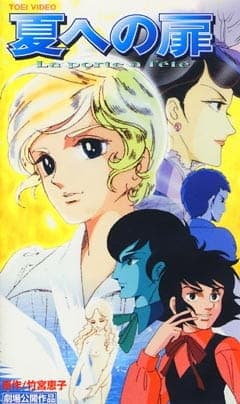
Marion is a young schoolboy who prides himself on his adherence to a philosophy he calls "rationalism". Because of his disdain for emotional display, he ignores anything remotely akin to affection. But when he's entangled in a romantic affair with an older courtesan, his rationalism is revealed to be little more than a cover for his own emotional immaturity. Learning to love, Marion blossoms under his older lover's care but unfortunately, Marion has yet to learn the true price of the affair.
(Source: ANN)
Nenhum episódio encontrado.
Comentários
Arsene_Lucifer
Natsu e no Tobira/The Door Into Summer in English is an animated film from 1981 based on the manga of the same name by Keiko Takemiya. A pioneer of shonen-ni/yaoi manga in the early 1970s whose short story, Sunroom ni te, contains the earliest known male-male kiss in a shojo manga. She’s an accomplished mangaka whose contribution to her field is far more interesting, and engaging than this Madhouse and Toei produced animated hour-long film. It’s a relic of the past that is better left collecting dust. Natsu e no Tobira attempts to be a coming of age story tackling the idea of rawlove in youth. Unfortunately there isn’t enough material for it to delve into its own chosen subject. Right off the bat the film opens with intrigued starting at a future point with two friends in a twenty paces pistol duel with main character Marion in his attempt to stop them. This opening is stylishly presented with field of red roses contrasting against a dark sky along with black and white human characters figure in the pouring rain. This opening scene is a good hook in making the viewer wonder what led up to this moment. Everything after this opening is an immediate failure.
For starter, the biggest issue for this coming of age film is there’s virtually no characterization. Without establishing how the central characters were before experiencing their life changing events it doesn’t feel like they learned anything from their conflicts. A character in the film reveals he has feeling for his male best friend which isn’t hinted at any point in the film. It’s a spontaneous revelation that only brings to mind crucial questions. What made him fall in love with his friend, and how long has he felt this way aren’t answered. Presenting itself more in the way of an over the top soap opera exaggerating every major scene. Similar dramatic scenes are presented in ridiculous way, but are not enjoyable because they’re meant to be taken seriously.
Another issue is Marion is a boring main character. He, like the rest of the film, is simply going through the motions of events without setting up a proper groundwork. Marion point of view on love is of that of a fairy tale, but he’s too shallow to be sucked into the emotions he's going through. There are only few lines of dialogue that attempt to characterize Marion, and give a bit of backstory, but they’re delivered in a throwaway manner not allowing time for those plot points to sink in before another event happens that progresses the story. The dialogue in general revolves around love which gets repetitive when characters have no other things to talk about.
There’s a scene where our characters see the dead body of a friend that committed suicide. One of them acts appropriately being sadden at the lost of a friend only then to utter out loud he wants to be hold by the woman (who's in her 40s) he loves. In the background of the same scene two other characters talk about dueling to get a girl hand in marriage. A friend of these characters killed himself, learn about it recently going to the site, and they are so self-absorbed in their own problems to pay to their dead friend any proper respect. Other characters don’t fare any better. Marion is one-dimensional while everyone else are more in the cookie cutter variety. Nearly all the characters have a conflict revolving around love, aren’t developed to make any said change meaningful, and are treated as plot devices.
Madhouse and Toei Animation who are responsible for putting this anime movie together were faithful to the manga which is a negative. The manga is a single volume, less than 80 pages manga telling the same exact story which would take an average reader less amount of time to read in its entirety than watching this film. There's not enough material to extent into an hour-long film. Unfortunately the added scenes don’t improve an already short story with rush pacing and shallow writing. It’s bloated with scenes dragging out in order to be extended to an hour length. Instead of expanding on the basic story it inflates itself with material that doesn’t do much in the long run to improve the source material. One of these decision is giving supporting characters more screen time, but that doesn’t amount too much since supporting characters are simply tools to advance to the next scene.
All the characters look feminine, especially the males. Emphasizing beauty of character over anything else. Containing sparkling eyes, smooth skins, and gorgeous similar looking hair cut. None of the character designs standout being exactly what you would expect from a Shojo that doesn’t attempt to standout. The background is generally blurry in line with a wispy like style. With the exception of the flower field where the duel is held backgrounds are dull to look at with minimal detail paid to them.
The music is composed by Kentaroh Handeda whose score is a mixture of violins, saxophone, piano, and low-key singing of lalala lyrics. If you allowed a giant pile of cheese to produce music for this anime you would get the same result. Not a single memorable track helps the anime in any positive way. There’s a terrible sex scene in the film which is made worse by jazz like music combine with animation that attempt to make it look poetic. The result is one of the worst sex scenes you could see that’s animated. In general the music is forgettable and has the power to put anyone to sleep when listening to it.
Voice acting from the entire cast is weak. Granted the material wasn’t good in the first place, but the voice work doesn’t fare out better with the vocal performances. The gender roles are basically reverse in their performances; the females are reserve, and the males are more emotional. Like with everything else in the film the voice acting leaves allot to be desired. In general being trite, unconvincing in relaying across any proper emotion in their line delivery to make them believable.
Natsu e no Tobira has a lot of problems, but the one thing the anime movie does better over the manga is the pacing so everything in the film flows more naturally. While there isn’t enough substance to justify its own length at least it unfolds in a more proper manner than the manga. However, even with that small praise it clearly went to waste. Madhouse and Toei studio both failed to add anything to something that was already rushed, and shallow from the source material managing to make it worse in animated form.
Haneken2086
Adolescence has always been a turbulent time. It marks the no-man's land between childhood and adulthood, where you have to balance your desires and needs with your obligations and responsibilities. Anyone too repressed is bound to crack, and anyone too carried away is bound to do something irrevocable. If you don't learn to maintain balance, you could change things forever. This is the lesson four schoolboy friends on summer vacation – Marion, Claude, Lindo and Jacques - learn the hard way. The stoic and firm Marion is seduced by an older woman, which teaches him about emotional balance; his devoted friend Claude strains under a secretpassion; and Lindo and Jacques quarrel over a girl they both like, which escalates into a duel to the death...
The story was written by Keiko Takemiya, an anime/manga writer who pioneered stories of relationships between males (both physical and platonic); thus the tale is sensitively written, mostly focusing on the boys, their personalities with both virtues and vices, and their development over the course of the film. The female characters don't get too much attention, but they serve as catalysts for the boys to react over and what time they have is well used.
The feature boasts a rich, moody atmosphere to the tale, in which the animation changes according to the tone; romance and joy are portrayed in misty pastel visions, while passionate dramas are stormy and stark vignettes. One of the best scenes in the feature is of Marion finding Claude having a breakdown in a stable, which is both desperate and heartbreaking. The story also contains an air of impending doom and nostalgia through the viewpoint of an extended flashback, when the boys were younger and the outcome of the duel has already occurred...
The voices are well done, featuring a cast of now-veteran voice actors who were in their early years (it's not often you hear Yamcha and Piccolo go to war over Luna LOL). The direction is also very good, displaying both restraint and expressiveness. But the top draws in this are the artwork and the music, which enhance the film's story and turn a standard coming-of-age drama into an emotional voyage and roller-coaster (with the latter slowly and unstoppably overwhelming the former).
Overall, it's a very unique feature in anime, in that it's a mood piece (a rare thing nowadays, even for Western animation) and that it's one of the best mood pieces ever made. A great watch, and a heartbreaking ode to turbulent adolescence.
ZNoteTaku
Reason is, and ought only to be the slave of the passions, and can never pretend to any other office than to serve and obey them. ~David Hume, A Treatise of Human Nature, 1739-40 Someone once asked me how to best describe *The Door into Summer*, and the word that came to mind is “humid.” The film resides in that certain kind of summer afternoon where the sun is overhead and the clouds are beautiful, but the air is dense and heavy, as though it was so thick that you had to swim your way through it. The characters all feel the weight of imposing emotional pressureupon them, while their inner restlessness leaves their personal feelings practically begging for an exit, yet constantly being denied. Just as a humid day doesn’t need much of a push to make the rainclouds move in, the characters can only hold themselves back up to a certain point. And it’s when they move past the point of no return that the torrent of rain overtakes them, innocence lost forever in a swoon that is both visually gorgeous and morally grotesque.
At the film’s center sits Marion Fiesse, a handsome boy of Europe’s fixation with rationalism. Self-assured of his own mind to the point of nauseating, he always finds a reasonable justification for anything under the sun, even reading the “truth” behind his mother’s letter wondering if he’ll join her and her new husband over the summer recess. Though historically framed within a certain ideology, Marion’s personality lies in that uncomfortable teenage time when you are somewhat drunk on your own hubris, that you know everything there is to know and that you have it all “figured out.” Anyone who has been a teenager knows that such is never the truth, but it’s an illusion that we all become privy to at some point or another, and in our own way. After all, how could someone claim to be so rational, yet throw themselves into the path of an oncoming train to settle an argument? All the flowery, elegant words don’t change someone being fourteen years old.
But rationalism is wielded by Marion and his group of friends like an armor, for which Marion is its greatest knight. Adored by nearly everyone he encounters, he even has the affection of the school’s most beautiful girl, Ledania Francois. But for Marion, the concept of allowing any kind of emotion, and especially affectionate emotion concerning Ledania, to cloud his judgment or enter his life in any meaningful capacity is unthinkable. For as much as Marion might voice the illogic of the rules that govern the students during the summer, there’s one rule that he clings to more tightly than any other: the door to the emotional side of his heart is to be shut tight forever, never being allowed to let his “irrational” feelings see the summer light. Let them be repressed forever in the dark.
Beyond the foolishness with the train, the cracks in the façade begin to show. Marion meets Sara Veeda, a woman who expresses her thanks at Marion stopping the train, and kisses him. Marion is justifiably repulsed, but he cannot get the candidness of her kiss and comments to him out of his mind. In his blind lack of understanding in the ways of love, he is choked by the pouring rain and the oppressive humidity of his heart, swimming through agony until he finds himself suddenly in Sara’s home, nude and vulnerable. His rationalism, and the misogyny he held tightly onto to try and keep his feelings under control, bounces off her with nothing to stick to. Unable to run away and with no defense against her emotional current, Sara seduces him. Marion fashioned himself as an immovable object, only to encounter a force he found completely unstoppable. The door to Marion’s heart is violently opened, straight into—and into—Sara’s waiting body.
Make no mistake about it – this relationship is not consensual, and even taking into account the time period of the story, this kind of relationship is more than enough to tilt a head or raise an eyebrow of any viewer who might be watching, if not worse. *The Door into Summer* acknowledges this to be the case, framing the entire story as a tragedy from its first minute and making clear that, as beautiful as Sara is, her presence sets the dominos in motion to bring about Marion’s final torment. The music, vocally seductive and wispy and with yearning timbre through its strings, oscillates between major and minor through mode mixture, revealing both the exhilaration and underlying darkness of the world Marion has entered. He falls into a vortex of feelings he has long since denied, now growing out of control in Sara’s hands, and at the cost of nearly everything else in his life. What was once important seems unimportant, from friendships to social tact.
Marion’s change does not go unnoticed, and his time with Sara causes the undercurrent of his friends’ own emotional qualms and struggles to also come out. With their knight having abandoned them, they too are thrown into a series of horrible collisions and tears, consumed by an all-encompassing heat that causes tempers to get frayed and rash decisions that defy any sense of reason beyond traditional notions of honor. Left in the wake of their troubles, they never learned how to reconcile them. Ledania, the most emotionally forthcoming and conscious out of everyone in the cast, can only watch the melancholic wheels turn and the humid air in the sad narrative sunset.
Perhaps the ending of the story could have gone differently if the characters were a little more forthcoming with their own honesty. Wondering about this though, I would argue, misses the point. *The Door into Summer* captures just how helpless people can be when at the mercy of feelings that they do not understand, or to be more precise, **choose** not to understand. It is a warning that feelings that arise from moving into the realms of love for the first time are both raw and powerful. To repress them or pretend they don’t exist is to deny oneself not only happiness in the general sense, but a healthier kind of happiness rooted in emotional reconciliation and maturity. There is a dismaying irony in that Marion denied his feelings under the auspice of logic yet did not have the logic to realize that he should try and understand those feelings beyond simple dismissal. And because of that, with or without that encounter with Sara, one thing is certain – Marion’s life could only end one way.
There's a moment in the show where it says, "But even though they spoke of greater things, they weren’t adults yet."
Indeed, they weren’t.
Chuy_diazz
A journey through MadHouse chapter 8: one of the pillars of shone ai. The central theme of the film is the passage to maturity through love. The story is not limited to telling a common summer romance, it will use all kinds of love that its duration allows. The sexual awakening of a relationship between an adult woman and a teenager, a homosexual love, unrequited love and even a kind of a rather twisted love triangle. The story is made so that you question each of the characters and their actions. That the axis of the story is romance does not mean that everything you aregoing to see will be pretty as we are used to. Throughout the work you will see all the characters involved do both good and bad actions. In the end what matters most is what each character is going to learn from what they did that summer.
The story touches on many themes, which although they have been explored individually today, I am impressed by how brave the story was in touching on these themes in the 80s. I would like to address a couple of themes here so you know what you can expect.
The first theme would be the unfaithful relationship between an upper class woman and an underage teenager. For the time it may have been a common practice, but beyond the fact that the woman took advantage of the child, the relationship left him with more things beyond a broken heart. How to be loved but most importantly how to love. There are many stories about self-love but the fact that the work talks about how to love someone in a dangerous mental state is a message worth analyzing.
The other theme is the stigmatization of homosexuality in the time in which the film is set. It is not about showing us a romance between two men, it is about showing us the consequences of hiding this orientation so as not to bother society. Speaking from the religious stigma that being homosexual was being possessed by the devil, tells us a lot about the prejudices of society at that time. This homosexual romance does not come with the intention of giving us a happy ending in a time where they could not be. It only comes to show us how much times have changed and that it is now more accepted by the vast majority.
Natsu e no Tobira is a film that must be seen for two reasons: the first being its historical weight as one of the works that paved the way for modern shonen ai. The second for all the richness of the plot that it presents in almost an hour and a half of duration. When you finish watching the film, there will most likely be two or three topics that you will want to discuss with people who have also seen this beautiful film.
ProudElitist
And, once again, I see people gratuitously crapping on a very good anime because reasens, and I sincerely don't understand why. What I saw here was extremely good and stylish animation, extremely good voice acting from all parts included (the voice of Sarah is so goddamned sexy it hurts), interesting story perfectly in vein of what the author of the original manga did in other works like Kaze To Ki No Uta and even with less forced moments (and for forced I mean actual rapes, in here there is no rape or violation of sorts), good and enticing OST, what is the problem of peoplewith this? because it's not "manga accurate" enough? who cares, this is a jewel of an anime that is leaps and bounds better than the sufficiently entertaining one they made out of Kaze To Ki No Uta, and it's a shame not many people know of it. Watch and rewatch this and enjoy it in full for the piece of art it is.
fatal_strategys
Regularly scheduled disclaimer: I don't believe in the MAL rating system, so ignore everything but the overall score if you actually want to know my opinion for some reason. Natsu e no Tobira is, like many films from this era, more interesting from a historical perspective (in this case as one of the earliest depictions of gay characters and perhaps the first proper BL anime). Unfortunately unlike films like Ashita no Joe in a similar position, its characters are lacking the core appeal they need to make the growing pains of anime as a medium more tolerable, and ultimate there isn't much to actually sayabout the film as a piece of art beyond its historical context. It is, at times, very pretty, but its style doesn't particularly convey a depth of character or an interesting enough aesthetic to really justify the existence of the film. None of the characters are necessarily unlikable per se, and I actually do think that thematically it is fairly interesting: an exploration of the passion of love and youth and the inability to rationalize them, the way neglect can prime people who think they know better for abuse, etc. However there's just not enough substance or nuance here for me to say that those themes are explored well.
To keep it short, this film certainly has historical interest, and isn't particularly long, so if you're curious about the origins of BL and want to observe fairly pretty art for a while, it is worth checking out. From a purely artistic perspective, though, it ultimately falls short.
ooReiko
This film is an astounding portrayal of sexuality, youth and the struggle of emotional growth. The visual presentation for these themes doesn't leave anyone cold after the experience that is this film. The film builds up towards its premise from the start utilising excellent design and visual touch for the atmosphere and flow. These elements enable you to relate to the MC his struggle and relationships around him. The art enables you to see the events unfolding through the eyes of the character, which I think adds another layer of immersion into the film. You can pretty quickly pick up on the MC and his philosophytowards his inevitable emotional struggle and position relative to the relationships around him, this serves as the premise on which the film builds up its presentation. The philosophy of the MC is presented through the lens of an adolescent individual and the characters and their design match this portrayal. You can see the adult characters of the film have complete control over the younger characters in this film. This is presented both visually and metaphorically throughout the film. The main characters struggle relates to his own philosophy versus the overwhelming presence and control coming from a stronger entity. This adds another layer to the theme of sexuality and control of yourself that relate to the philosophy of the MC.
The relationships of the MC are another main theme of the film, his position in relation to his peers is brought in question not only by himself, but also other parties. He is not sure about himself in regards of his relationships and his position in those relationships, which partly creates the struggle that is portrayed in this film. Throughout the film he tries to deny himself in relation to his relationships culminates into an internal conflict, that is presented visually as the climax of the film.
The art and music of the film reinforce the MC position relative to his relationships around him and in some shots he is portrayed as strong among his peers compared to his portrayal against the controlling entity where he was frail and defenceless. This visual presentation is one of the finest I've seen in any anime and it definitely adds another layer of depth into the film. The music compensates the artistic portrayal and keeps you engaged to the visual experience constantly.
Overall this film artistically presents one of a kind experience through youth, sexuality and self discovery.