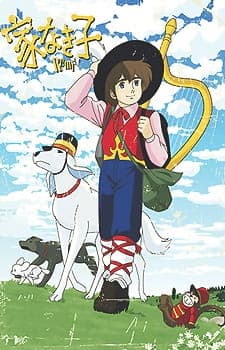
Remi is a boy living happily with his mother in the French countryside. But everything changes when his estranged father comes home and, in desperate need of money, reveals that Remi is adopted, and sells him. Heartbroken, Remi ends up with Vitalis, a traveling musician, and his troupe of animal entertainers. Together, they travel the country in search for Remi's real parents, along the way learning the harsh lessons of life. A deeply moving story about friendship, loss and the pursuit of happiness.
(Source: AniDB)
Nenhum episódio encontrado.
Comentários
Firechick12012
Update: July 12, 2025. I decided to rewrite my entire review from scratch, as my old one was way too slipshod and overly gushy, fangirly, and not up to par with my reviews now. Back in June of 2010, when I was in my junior year of high school, Anime News Network announced that they would be streaming an old series from 1977 called Ie Naki Ko, or Nobody's Boy Remi, alongside many other shows. ANN would put up five subbed episodes every week, and it was their first license directly from Japan. Back then, I was still forging my tastes in anime, but thought thisseemed interesting, as its premise reminded me a bit of Les Miserables Shoujo Cosette. Let me tell you, I was hooked from the first episode, and absolutely DEVOURED this series every time episodes were dropped each week. It really struck a chord with 16/17-year-old me. Sadly, ANN is no longer streaming Remi, or anything else. I didn't learn of the existing home video release it had until much later, and by then it was long out of print. Luckily, fansubs were easy to come by, and in 2025, AnimEigo (The new iteration of it, that is) released it on blu-ray. I bought that blu-ray set as soon as the MediaOCD store got early copies in. Seriously, rewatching this show has been a really sobering experience in the best way possible, and I still love it now as a 32-year-old adult woman as I did back when I was in high school. But you're probably wondering why I'm making a second review of this, as I previously reviewed it back in 2010. Honestly, that review was one of my first attempts at seriously reviewing/critiquing something, and re-reading it...yeah, it's rather slipshod and overly gushy and fangirly, so like with my reviews of AnoHana, Les Miserables Shoujo Cosette, and Digimon Adventure, I'm rewriting my review from scratch so it'll be up to par with my current stuff.
Based on the 1878 French novel Sans Famille by Hector Malot, the story centers on an eight-year-old boy, Remi Barberin, who lives a happy life in the tiny French village of Chavanon with his mother. His father, Jerome, is away at work, so he does his best to help his mother run the house. When Jerome is suddenly dismissed from service due to a work injury and returns, Remi is in for a shock—Jerome scathingly reveals to him that he is not their biological child, and has no obligation to keep him. In spite of his mother's protests, Jerome drags Remi away and sells him because he's in dire need of money. Remi is purchased by a circus performer named Vitalis, accompanied by his three dogs Capi, Zerbino, and Dolce, and a monkey, Joli-Coeur. To his surprise, Vitalis turns out to be the kindest and warmest father figure he's ever had in his life. He teaches Remi how to read and write, dotes on him to no end, and disciplines him when needed. Remi becomes part of the Signor Vitalis Troupe and they hold shows all over France, with Remi becoming an expert performer under his new adoptive father's tutelage. As Remi crosses paths with many enigmatic people both cruel and kind, including a feisty violinist named Mattia, a former student of Vitalis named Marcano, a cruel caretaker named Garofoli, an unscrupulous gang known as the Driscolls and the aristocratic Milligan and Acquin families, he strives for one thing: to find his true family.
At this point, I haven't read the original novel, so I can't comment on the show's faithfulness to the source material, but from what I've heard from other sources, this series is noted to be pretty faithful, albeit with several significant changes. It helps that with the series being 51 episodes long, it makes optimal use of its time to flesh out the story and characters, resulting in a series that is pretty well-paced for a show of its era. It probably expands on a lot of events and characters too, for all I know. I need to get around to finding an English translation of the novel some time, if I can find one. Oh, and I should probably warn you that if you ever plan on watching this, let me tell you, Remi is dark. Remi has to deal with being sold off by his adopted dad, having several friends die undignified deaths, facing abject poverty, hunger, wild conspiracies, and so on. Don't worry, it's not dark to the level of, say, Magical Girl Site or Platinum End, where everything is completely mired in misery porn. I'd argue Remi's level of darkness is akin to Digimon Tamers or the Fuga: Melodies of Steel games, having its dark moments be appropriately serious, but still having plenty of levity and humorous moments when needed, so it's not all doom and gloom. But the drama in the series is pretty immense, and you have to be able to tolerate some level of 70s melodrama if you want to enjoy this series.
But simply dismissing Remi as a dark children's anime would be doing it a massive disservice, as there's so much about Remi as a show that really allows it to shine, starting from its animation. For a show that was made in 1977, it had a pretty high budget for that time period. We all know that Osamu Dezaki, who directed this, really loved experimenting with all sorts of animation techniques, often on a tight budget, from his favorite elaborately drawn freeze frames to having certain scenes repeat several times in a row. The actual animation is almost theatrical quality, which is rare for a 51-episode series like Remi. Backgrounds are immaculately painted, really capturing both the pastoral countryside and the dirt and grime of the cities and slums. Actual character motion is snappy and smooth, sometimes deliberately jerky or slow depending on the scene and context, and because Dezaki and his team made constant use of multi-plane animation, pioneered by Disney in the 1930s but seldom used in anime at that point, everything is constantly moving even when there's very little animation. But the anime has a unique style all its own when it decides to go all-out with surrealist imagery and psychedelica, usually used to show how a child Remi's age views a world that he has no frame of reference for. Colors are more vivid, dangers look more menacing, and strange things are downright creepy. Speaking of the backgrounds (Courtesy of art director Shichiro Kobayashi of Angel's Egg, Utena, and 90s Berserk fame. Yes, really), the layered backgrounds aren't just to give Remi its unique look, as I recently learned that Remi was actually the first and only anime series made to be viewed in 3D, but not the type of 3D you're thinking off with the red and blue 3D glasses. There's this concept called the Pulfrich effect, a weird optical illusion involving the different processing times between both eyes, induced by dimming one eye, resulting in anything that moves horizontally given the illusion of depth, which is why the multi-plane animation is used. Copies ordered from the MediaOCD website contain specialized 3D glasses that you can wear and see this in effect, if you want. Not sure if I recommend watching the entire series like this.
The soundtrack is also pretty good, if a bit dated, and it leans much more into the series' French setting, with a lot of accordions, strings, and percussion. Given that the music is done by Takeo Watanabe, who previously made the scores for anime such as Heidi, Dog of Flanders, Candy Candy, Rascal, and Perrine Monogatari, he definitely manages to bring his experience here, knowing how to utilize the different sounds and instruments to achieve their intended effects, and it works really well here. The opening theme is nice, though I do feel the ending theme is a bit too peppy and overly cutesy for the series considering the show's tone is much darker than it, which results in quite a bit of mood whiplash at times. There are times when the voice acting can lean a bit too theatrical, but I never found it to be too annoying. All the voice actors do great in their respective roles. It is kinda funny learning that the late Masako Sugaya, who would go on to play Uran in the 1980 Astro Boy anime, a character who I've made no secret of the fact that I don't like, voices Remi here with the exact same tone of voice.
Speaking of the characters, let's talk about them! Remi as a series has no shortage of characters to follow, even if the main cast is relatively small, especially for a 51-episode series. If you ask me, all of them are wonderfully well-written and developed, constantly evolving as the show goes on, and are consistently engaging throughout. Even characters you don't expect to receive much in the way of personality, such as Vitalis' dogs, are given unique strengths and flaws that are used wonderfully. One example of this is Zerbino, a dog who steals food on a regular basis. His actions create a lot of tension throughout the series, and it forces Remi, Capi, and Vitalis to really develop and grow up when trying to deal with him. Not to mention that Zerbino's gluttony results in a pretty significant event, which I won't spoil. Remi himself starts out as a naive, sheltered 8-year-old dealt a bad hand, and in my opinion, his growth and development is easily the best part of the series. We get to see Remi grow and mature into a more well-rounded person thanks to Vitalis and all the people he encounters throughout his life, even when things are at their bleakest. It's especially noticeable when you compare how he was with Vitalis in the first series to his interactions with the street urchin Mattia, who joins him in the second half. Actually, one big change the anime made compared to the novel is Mattia's characterization. In the book, Mattia was a more passive, weak-willed character, and the anime decided to completely change his characterization, making him more of a scrappy, sassy, intelligent Artful Dodger-type kid. I haven't read the novel yet, but I do think this was a good move, as Mattia's different personality from Remi allows them to have a fun dynamic and stronger chemistry with one another.
Remi is a story that doesn't pull its punches when it comes to its themes, exploring the highs and lows of what life could be like for traveling entertainers in 19th century France, from things like police brutality to showing how prejudice can affect those on the receiving end. Unlike most sad stories nowadays, which seem to revel in their misery and milk it for all its worth when they don't need to, Remi's treatment of its themes and overarching messages comes through better, done with subtlety, never resorting to beating you over the head with them, even if the acting and Dezaki's usual stylizations can make it seem more theatrical than it should. Granted, I did learn recently that the ending is drastically different from that of the book, which supposedly misses the point that Malot was trying to make in the original. Again, I haven't read the book yet, but I'm honestly not sure why Dezaki and his team decided to change the ending. There's also one instance where a 1976 roadmap is used in the series, which is really weird when your series takes place in 19th century France.
However, for all that I praise Nobody's Boy Remi, it does have a pretty big flaw, and my feelings on it are the same now as they were back when I first watched it: The narrator. Good God, this damn narrator just won't shut up! Seriously, this narrator goes on and on and on in just about every episode, from voicing Remi's thoughts, to describing the geography of France, to, most egregiously, spoiling big reveals and plot twists before they're set to actually happen in the show! Granted, I do feel Lady Georgie's narrator is much worse in this regard, in that the narrator in that show was much more obvious in spelling out the characters' feelings and thoughts in a way that came off as really condescending to its audience, like the show felt it couldn't trust its audience to remember what happened literally seconds ago. That said, the narrator in this show is still really annoying in how much talking time he takes up compared to the characters in the show. Seriously, show, trust your damn audience!! Thankfully, Osamu Dezaki and his team seemed to realize this, as when they went to work on Treasure Island after Remi wrapped up, the narration was significantly dialed back, and the few times there was narration mainly consisted of just Jim voicing his own thoughts.
But you know what? After all this time, I'm so glad Nobody's Boy Remi is coming back into the limelight, and we all have Justin Sevakis to thank for it. I don't know what kind of person I'd be now if I hadn't seen Remi on ANN back in 2010, and I don't want to even imagine it. It's a well-crafted anime that absolutely resonates as much now as it did 48 years ago, and honestly, I wish more anime like this were made these days, because there's a startling amount of people who think "Why would anybody want to watch anime that's super depressing? We don't need that downer stuff nowadays, we need more happy, wholesome, and uplifting stuff!" To that I say, if you don't like sad anime, that's fine, you don't have to watch it, and your reasons for refusing are valid. However, to simply dismiss shows like Remi as just "child suffering fodder" is doing them a massive disservice. I don't watch shows like Remi because I enjoy watching animated children suffer. I watch them because they're amazingly crafted, made by people who have care and passion for what they're working on, and actually care about stuff like character development and intelligent storytelling while respecting its child audience. It's honestly both sad and kinda disturbing to me that people are treating anime that are even a little bit sad, uncomfortable, or disturbing like some kind of radioactive substance. Hell, Remi's whole message is about overcoming impossible odds and not losing yourself no matter how bad things get, and really, shouldn't that be what we need now, in these troubled times we're living in? Seriously, this new purity culture we're living in is starting to get ridiculous. I mean, we're living in an era where people are not only actively campaigning but actively erasing literally any LGBT media or history ever just because they don't want it to exist. So yeah, Nobody's Boy Remi is one of my favorite anime ever (And I love the 1997 version just as much), it's still just as good now as it was when I watched it at 17. If you want a genuinely awesome show that won't pull its punches, give Remi a shot, especially now that AnimEigo's blu-ray is out.
bubble
Ie Naki Ko is based on Hector Malot's novel Sans Famille (the English version is called Nobody's Boy). I saw part of the Japanese version and part of the French one (the latter on DVD - the French Canadian release). I am not familiar with the out-of-print U.S. version, so I cannot speak to its quality. The story is great, and really heart-wrenching. Remi and his friends go through hardship after hardship, and at times the future looks very bleak for them. The adaptation is usually but not always faithful to the novel. I personally prefer the novel's ending to that of the show, but otherwiseI loved the story.
The art is great for the time. That is to say that the colors are not as clear as modern digital releases, even in the DVD version, but the level of detail is pretty good, the faces are expressive, and the scenery is sweeping. Many scenes are dreamlike, reflecting Remi's emotional state. There are some scenes with static images on moving backgrounds, and other shortcuts, but only as much as is common in anime. The colors are realistic - no pink-haired people in this show - and the thin lines and detailed linework is unusual, especially for the time.
There is a good deal of music, especially once the characters start performing for money. I enjoyed it as a rule, with the exception of the theme song in the French version, which was annoying and stuck in my head. The original theme music was better. The voicing was quite good in both versions and the music added to the mood of many scenes, meshing nicely with the art. Of course you're not going to get amazing surround sound on a show like this, and there wasn't a song that really stuck out to me as a favorite, but the music definitely added to the experience.
The major characters - from Remi to Capi, the leader of the dogs, to Vitalis, are endearing. I have to say it's unusual to see animals portrayed this well in anime. Some other characters are thoroughly detestable, but I found that even in the most emotional parts of the show, I kept watching for Remi's sake.
I had a few issues with the show in terms of historical accuracy. I can recall at least one instance of random English - "Coffee" on a sign in a tiny town in the middle of nineteenth century France? I also found the Japanese labels on the map of France distracting, especially once I switched to the French version.
I really liked this show and would recommend it to anyone who likes tearjerkers and older anime.
A couple notes on the Quebec release - it's called Remi Sans Famille (or just Remi) and I suspect the video is taken from the US version, because there are credits in English at the end of each episode. Also, the episode summaries reflect the plot of the book more closely than that of the show. This release is French-only, which is sad, because the French audio really is top-notch, as well as being the only version in print in the North America.
Atelier_Weiss
Nobody's Boy Remi, or "Sans Famille" in French is one of the monoliths of classic anime. Coming from the 1970's, directed by the prolific Osamu Dezaki and equally prolific art director Shichiro Kobayashi; written by famed French writer Hector Malot known also for his sister novel En Famille, or the 1978 anime adaptation Perrine Monogatari by Nippon Animation - Well known for their adaptations of classic literature under the moniker World Masterpiece Theatre or at the time of its airing, Calpis Family Theater. Helmed by two of the greatest studios of their era MADHOUSE and TMS, you have a show with so much riding onit that you could only count other anime with the same level of prestige on about two hands.
Put simply, this anime is critically acclaimed and the question remains whether or not it deserves it.
Chronicling a portion of titular character Remi's early years, this story follows him not quite as a teenager yet upon being sold by a travelling performer and learning to survive as what is essentially considered for the era as an extravagent beggar. Trekking across the harsh landscapes of France with no ensured stability, Remi and his master Vitalis are tasked with a simple yet incredibly arduous task - To live day to day. Like providing everyone with shelter on a rainy night, or having enough bread to split evenly between the entire troupe; always moving towards a new destination of aspiring onlookers that are willing to throw you a morsel of financial reprieve. The life of one who performs from town to town is difficult and many people don't look upon you with envy, but rather pity.
Remi is a sad but endearing story that provides a look into a life that truly isn't a fair one. Remi experiences more loss, heartbreak and hardship than most people experience in their entire life in the span of a few years. Melodrama that doesn't happen because it has to, but because it's inevitable. The journey of life isn't a straight road, but a rough pavement filled with potholes. They may appear easy to avoid when looking at them objectively, but the human heart doesn't think objectively nor does it allow itself to easily perceive those potholes. So you fall, grab on at all costs and do everything you can to climb back up.
The question that someone may ask themselves is "why continue to be a travelling performer? Why not find a job in a mine or farm or something more stable"? What purpose is there in living day to day, town to town, extravagently scrounging for money off the goodwill of others? Why practice a hedonistic sense of purpose that can very well lead you to a path of obscurity? There are questions that you can't answer definitively, and trying to find the answer isn't the goal. Vitalis' goal with Remi isn't something you summarise with a sentence to accentuate his aspiration to do so. He wishes to share his love, passion and regrets in life to give another the chance to survive in a brutal world willing to cut you down when you least expect it. He desires to teach Remi of life itself, and the many kinds of joys that exist within it.
The truth that Vitalis offers isn't an objective one, but of many truths that he learned through a long, hard and fulfilling life. One that allowed him to appreciate and love an aspect to life. It's a commonality for older people to hand down their wisdom to younger generations. It may appear as bothersome, presumptuous or out of touch to many younger people, but the reason is often because they've simply lived longer. The older you get the more you realise just how much you can appreciate the sanctity of a satisfied life. And it's interesting when you consider that he's the oldest recurring character in the show.
So Vitalis brings Remi up to follow his passions, but he does so not as a watchful hawk. Remi lives his life with Vitalis' upbringing keeping him in check, but never to dictate how life should go. Remi always reminds himself of what Vitalis would tell him in his moments of hesitation. Vitalis represents Remi's conscience and moral compass.
It goes without saying, Osamu Dezaki + Shichiro Kobayashi is arguably the greatest pair of old anime. No director understands Kobayashi's truly emotive, naturistic vision as well as Dezaki does. As someone who popularised so many directing techniques he's able to bring out every bit of Kobayashi's potential as a visionary. It's shot composition galore. Despite being 51 episodes this show almost never sees visual compromises in the layout or storyboard. All forms of stylistic and tasteful budget cuts are used to avoid overly complicated animation. Now sure, a more modern eye may look at all the still frames and think they're looking at a slideshow. Despite Dezaki being known for popularising the postcard memory technique among others, I would hardly regard anime directed by him as lacking in the animation department.
When you compare a similar show like Anne of Green Gables, the most apparent detail in Remi is how lively the animation itself is. Many shows of the era had far less in-between frames than you may typically see in anime today as animation is considered the most important visual detail for newer anime, but Remi manages to have more detailed animation than most TV anime that came out years after it. Part of the impressive nature is how it so cleverly hides the use of reused animation. Unlike say an anime with transformations, Remi's obviously far more grounded and exists with real world settings in mind. But as long as you're placing these animations within appropriate contexts you can use a completely different setting and you would never notice the same dancing animation is being used. These are treated as you would a transformation or signature attack in other anime, they're the animations given extra attention likely animated on more 2's instead of the usual 3's or 4's (in layman's terms it's animated more smoothly) for the purpose of being reused. It allows any typical animation not reused to particularly pop out with a lot of movement.
Now animation is all well and good but the real star here is Kobayashi. No contest. I'm not going to speak on all significant anime he's worked on as I haven't yet seen them all so it's not my place to make declarative statements accounting for general readers, but I will say that up to this point in all his anime I've watched this is my favourite work of his. This is including Rose of Versailles, Berserk, Windy Tales, YKK, Castle of Cagliostro and Utena, to name the most notable ones I have seen. You could chalk this up to my obsession for rural, early/pre-industrial settings or if you want a word to search up, cottagecore. I know I'm biased, but I think there's more to it than just that. This does in heavy part credit Dezaki for his incredible sense of constructing a scenario for Kobayashi, and needless to say that practically every anime Kobayashi's worked on looks great. But there's something deeper, more profound to be discovered within this experience to me.
I've watched an interview with Shichiro Kobayashi (toco toco ep. 17 if you want to look it up) and while many quotes stuck out the one that struck me the most was "I love this scenery, because there is nothing" which cuts to a simple footpath, a tree overhanging the pathway, shrubbery on the right and the left with a hilly terrain, and a man carrying a package with his pomeranian following closely behind. He then proceeds to stop in his place and sketch what I described in his own image. Kobayashi deeply understands the intimacy of art. A landscape portraying a rural footpath isn't just that to anyone, it can be heavily nostalgic; a pocket of time that's captured forever. It can be sad, reminding you of walking your dog during a dark time in your life. It can even bring a tear to your eye in ways you can't describe with logic. Art captures the emotions of an artist and presents itself to the viewer in however way their mind wishes to perceive it. It can reveal emotions you may not have realised you even possessed.
Shichiro Kobayashi's love of "nothing" is a love for his surroundings. Landscapes that you pass by everyday. Mountains, trees, footpaths, lakes, houses, towns of all sorts are pulled from his heart and transported onto paper. Remi is an anime that spends most of its time walking past these places just beyond your bank of memories, around the corner of that cliff or beyond the horizon and by god does it show in this series. There are so many still frames in this show that belong in official art books. From the many breathtaking parallaxing landscapes, astounding colour palettes that capture the warmth and harsh cold perfectly, to the postcard memories that are probably the best and most well utilised I've ever seen - Remi is a visual marvel that not only stands above and beyond practically all anime of its era and a few years following it, it represents a pure romance that goes beyond its story and directing. I feel like this is one of the reasons why Figure 17 is another one of my favourite Kobayashi anime, his sense and passion for naturalism within art is unmatched in anime which is what gives him the reputation of being quite likely the greatest art director anime ever saw.
I hate to end this segment on Kobayashi transitioning into Takeo Watanabe, cause I've already established Kobayashi as the undisputed MVP of this show. But no, I'm not doing this to undermine him at all (it just happened that way.) While a far lesser name than the aforementioned two, Watanabe is by no means a no-name and his work on this show is absolutely nothing to ignore. Most well known for his work on Heidi and Mobile Suit Gundam, Watanabe has a very distinctive style I believe most who've seen any of his shows would recognise fairly quickly. The use of accordion and mallet instruments in many of his tracks are a definable trait, creating a warm European innocence that often comes with the casts of shows he's involved in. There's a modest optimism - a sense of relief that makes you feel comfort in the story's direction. Until the tension rises. Watanabe's mastery of stark tonal shifts is his greatest strength. When the music is happy, you feel happy. When the music is tense, you feel anxious. This is a technique that can be expressed towards many soundtracks, but personally I've always found Watanabe to have an extra element that I can't pinpoint. When you're crying just by LISTENING to Heidi, Perrine or Remi's soundtrack and remembering the atmosphere, you know the music has successfully dominated your emotions.
I don't want to forcibly convey a sappy message of this show down your throat. Everyone knows that this anime is sad, besides it's significantly less depressing when you look at the big picture. Remi rewards your emotional investment. It's not aggressively stomping on your heart and leaving it out in the rain. It may do so occasionally, even frequently. But the message and lessons learned throughout Remi's journey are a testament to human endurance. This doesn't just apply to Remi, but to Perrine which by extension refers to Hector Malot as a writer. Both shows are reminder that people are good deep down. If you're willing to reach out, whether you're desperate for a helping hand or not you'll learn how valuable a bond between two living beings can be.
I don't think Hector Malot ever intended to have Remi summarised as depressing. The point is to understand how emotionally powerful all beings can be when they lean on each other and put their everything in living. When life is hard you work harder, and in turn learn more about the world and yourself. Being a traveling performer isn't about being an entertainer to Vitalis or Remi, it's about challenging yourself in life in a fulfilling way. Hardship brings growth, and growth brings enlightenment. True hardship that comes from living out in the world and getting to experience the best and worst of nature and people. No one can say for sure if enlightenment brings happiness, but maybe your own version of enlightenment will bring you closer to it.
Remi is a boy who doesn't belong to a predetermined fate, because life isn't predetermined. Despite being sold by his adopted parents, his life isn't the subject of pure misery. His life is his own to be decided, and his sense of purpose is something that cannot be understood until he experiences the pain to value and cherish life. And perhaps, maybe when you finally experience happiness, even that might not be enough to understand it. There is no way to know how or when you'll be truly happy, the only thing you can know is to follow your heart at all costs. Your mind may often lie to you and tell you to give up. But your body and soul will always remain intact as long as you cherish yourself with purpose and optimism.
Move forward, Remi.
deep3anime
I saw almost all of the World Master Piece Theater anime series and longed to see an anime with such quality and at last i found it. I saw 'NOBODY'S GIRL REMI' when it was telecasted in ANIMAX ASIA so i hoped that Ie Naki KO is the same. But no i am wrong it is far better than that. The story starts with a poor boy Remi, living with his foster mother at chavanas without knowing that she is not his real mother. Everything changes when his father (i.e., husband of foster mother) Jerome comes after 8 long years to visit. Hesells him to a travelling entertainer Vitalis who later found to be a famous opera singer. But this story proceeds very smoothly and makes you know about the sufferings of poor people for whom daily living is essential if not they had to starve. What i amazed is the boldness and endurance of this 8 year old boy who never seems to complain any pain to Vitalis as far as he is with him. But in the later portions he seems to enjoy the hardships.
Characters: Character wise Remi seems to mature in a more visible format. But never loses his purity in understanding others pains. But i must admit that Vitalis character is strong and he teaches an important lesson not only to Remi but also to the viewers that 'never depend upon others but march forward in life irrespective of troubles'. Mrs. Milligram who showers motherly affection to Remi once asks Vitalis to give Remi to her but the response he gives brings tears to all. Later on we too accept his decision as right. Another character i can not stop mentioning here is 'Mattia' the mischievous boy, who was considered violin genius. Actually he knows well how to live in this crooked world well. He is prudent in social living and like a detective he spontaneously makes acts to make the kidnappers to reveal the truth. I strongly assert here that, all who watch this anime will agree that without Mattia it would have been difficult for Remi to complete his journey. He guides Remi in the right path.
Art is not so good as today's anime but the story dominates everything.
Overall Enjoyment:
LONDON episodes were exciting very much as they made you empathize with him. Overall it gives more than enough satisfaction and drives you to make independent decisions for your life.
Nervin
The thoughts of being sold off to a stranger can instill in those fear and uncertainty, especially when considering that the one that is being sold is a mere happy (and unknowingly orphan) child, oblivious of the harsh conditions of the 19th century of France. Ie Naki Ko, or No Man's Boy Remi, narrates a sad, yet heartwarming tale of Remi and the hardships throughout his life as a travelling entertainer, learning valuable lessons about life itself. Although it is a beautiful anime, it suffers from some issues, the most notable one being the pacing of the story. The story of Ie Naki Ko is prettystraightforward, audiences being presented with an accurate historical representation of France and a simple lifestyle of some villagers, whose sudden average life is torn apart. Remi is sold off by his supposed father to a travelling entertainer by the name of Vitallis for monetary reasons, much to his wife's horror and the child's pain. However, it soon becomes apparent that the old, broad-shouldered man only has good intentions with the boy, saving him from his wicked foster father and poor life. This is visible through subtle characterization, which is shown, rather than narrated.
Throughout Remi's long and arduous journey, viewers are presented with a very realistic portrayal of France. Examples such as the wonderful rustic views of the french countryside, or the harsh conditions of that time, and with that, society itself. Other aspect to consider is the fact of being thrown in a job as an entertainer: it comes with both good and bad sides to it. The social standing of such people are lowly viewed and looked down upon by society, as well as the difficulties of the troupe, such as their income: searching for a place to stay, closely following their monetary balance are such examples.
As mentioned earlier, the anime generally suffers from some pacing issues in all the different arcs: most events could have been solved/displayed without dwelling on it that long, whereas there were instances where it was actually desired. Some examples, such as Remi learning to read or living on his own, could have been extended upon and used its time to portray how french society was faring in that period. Other thing that could have been displayed are the difficulties of the different classes. Nevertheless, those were just minor things. Surely enough, most of said events are very mundane, which added to the immersion of the story, in addition to creating a well-balanced drama within. Naturally, the whole journey of Remi may seem ultimately a very convenient one (especially in the last part), but it seemed to be the goal the anime was working towards to, that of happiness, and in that regard it executed it well.
Characterwise it could be lacking it the eyes of some, as the show focusses mainly on the main protagonists, Remi and Vitalis. Both are well-developed and fleshed out through the series, in addition to their motives. There is Remi, a good-natured boy who develops significantly alongside the story in a satisfying manner. Then there is Vitalis, who seemed to be at first a simple device to push the story forward, yet is the exact opposite: both mentor and like a father to the boy, whose ultimate motive is a very noble one. What is curious is how this character is developed: instead of being narrated and directly told to the viewer, it is carefully displayed and shown through his actions and images. This was very refreshing and worked significantly in favour of the anime.
However, the little background story regarding Vitalis could be seen as a bit lacking and disappointing, yet the sheer amount of fleshing out of his character was surely more than enough to compensate for it (besides of being interesting on its own). There are quite a lot of side characters shown throughout the anime, which hinders the expansion upon those a bit (which would have been nice to see it included), but this is ultimately due to the vastness of Remi's journey. For the most part, they are well presented to the viewer, serving their purpose.
Regarding the animation of this work, it is dated as expected with some rather rough motions, or still frames. Nevertheless, the art style compensates this issue significantly, with great hand drawn pictures of the wonderful french countryside or just the characters themselves. Occasionally, still frames are used to portray different atmospheres the anime is trying to portray with different colors, be it very vivid or raw. It must be said that for new comers to the `old school` visuals may be taken aback by it, yet I cannot stress that this is actually a very pleasant change to nowadays art style and direction.
Concerning the soundtrack used, it is at times wonderful and befitting of the situations, yet at times it felt a bit off, breaking the immersion within, yet as a whole was above average. This does not include some wonderful male vocals, which was a joy to listen to. As for the voice actors, these had their up and downs as well, sometimes either being too forceful in their interpretation or unconvincing; this was however a small drawback. The opening and ending were very suited with the use of simple instruments of that time, such as a harp violin, you name it
Ie Naki Ko was overall a beautiful anime, portraying the beauty and difficulties of life, yet sadly suffered from pacing issues as well as a bit of progression issues in the story. The art style was a very pleasant change to the current ones, as well as the great characterization of the main cast. It shows audiences the struggle of life, the hardships, and how one should always push forward no matter the situation. I can recommend this anime to viewers interested in drama, or interest in the a character driven story; the dated animations and sounds can be off-putting, yet it is certainly worth the try despite this.
Thank you for reading.
Rozette_Raven
Sublime! It must be watch. Remi, 8 years old, adopted, is rented by the father Barberin who can not work anymore. Vitalis, a street performer with three dogs and a monkey, embarks across France, and teaches him to read books and music. The recipes of the shows are poor, and they often live under the stars. It has humanity, optimism. When watching this anime during your youth, the score of 10/10 is logical. This anime allows a reflection on life: A child without family who follows an old man across France. What adventures! All emotions wake up. We are happy with Rémi when he does his shows, and we areunhappy when he is in the mines.
The life of the poor is beautifully painted.
All the themes of life are united: life, death, misery, love, friendship, solidarity. Rich in pedagogy, this anime teaches us very quickly the authenticity of life.
for all teenagers who want to live a unique adventure.
Another thing I liked: in the space of a few years, Remi, with Vitalis then with Mattia, made more than one tour of France on foot, like the companions of the duty, and the discovery of the regions, the Auvergne, the Velay, the Vivarais, the Quercy, the Rouergue, the Cevennes, the Languedoc, etc ... all these regions more or less disappeared under the administrative constraints, but which have, or had a cultural richness, interest me.
Rivers, rivers and canals that allow, at the time, Mrs. Milligan and his son Arthur to travel in France on a tourism barge, ... it's a dream!
loussi
This anime really bring the nostalgic feelings of my childhood. I remember crying while i was watching this as a kid but i do like that it portrays the hardships of life, i watched it dubbed in arabic and i think that for that time the drawings are well done. I don't want to put spoilers in here but i think this anime is a classic. Remi is really a boy with a hard life but he is trying to stay positive and keep on living with all the difficulties that he faces I don't actually like it that much now after watching it again i guess because igot used to the good quality of anime and i guess maybe because i watched it in a different language and now i feel like the original japanese is strange
Chuy_diazz
A journey through MadHouse chapter 4: a telenovela for children and otakus. Remi is the story of an adopted child who was sold by his adoptive father to a circus company. If you think that is the worst thing that could have happened to the child, it is because you probably have not made it past the first chapter. Remi, more than an anime, seems to be a bet to see who can break the child the fastest before taking him to his end. Despite all the unfortunate scenarios he gets into, REmi manages to get ahead thanks to his personality and the education he receivedfrom his buyer.
Despite what stands out the most is the drama and the misfortunes, the story has a good balance of sad and happy moments so as not to turn Remi into a martyr. It is a story that teaches us that there are good people and bad people in the world, that it is our job to take care of ourselves when we are getting to know a new person. Without a doubt, Remi was sold as a child, but when the story ended, we could see him become a little adult.
On the negative side, the worst thing about this anime is the narrator. Each chapter has a brief introduction made by the narrator and don't doubt that when that voice that knows everything wants to give a spoiler, it will do so and without stopping. You are constantly bombarded with spoilers of the story and you can't even control it because the narrator is so agile that when you least expect it, he has already told you how the anime was going to end.
If you want to get into old animes, this is a good option, since you will most likely have it available because it has dubbing in many other languages. If you have the opportunity to see it, enjoy it a lot since it is a story that you will not see again for a long time.