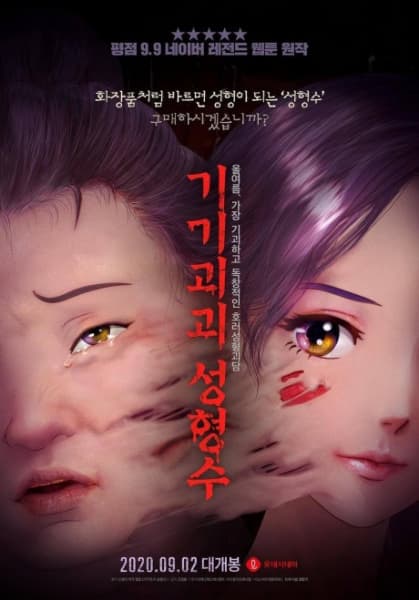
Beauty Water looks like a common skin cosmetic. But unlike other cosmetics, people can sculpt their skin with it like molding clay and change their appearance. An ordinary girl, Yaeji, comes across the 'Beauty Water' by chance, and her endless desire to be the most beautiful woman brings her unimaginable disaster.
(Source: Anilist)
Nenhum episódio encontrado.
Comentários
Deago
— ORIGINS — Beauty Water is a loose movie adaptation of the popular South Korean Naver Webtoon 'Tales of the Unusual', which was written by Seong-dae, an author who drew inspiration from the work of the renowned writer Itou Junji. Known for his strange and eerie tales that go beyond the horror genre, Itou Junji's influence can be seen in Beauty Water as well. Despite the movie's positive reception in South Korea, it has not gained much recognition outside of the country due to limited international marketing efforts. — INTERESTING PREMISE — It is a rarity to come across anime that authentically and realistically depict the social problemsthat women face in their everyday lives. While some anime series, such as .hack//Sign and Welcome to the N.H.K., have done an admirable job of highlighting social issues, they remain few and far between. .hack//Sign, for instance, explores the topic of escapism through online video games, which is a problem that many people, including women, face in the modern world. Meanwhile, Welcome to the N.H.K. tackles the universal struggle of transitioning to adulthood, a topic that is relatable to both men and women. However, they are not specifically gender-focused, which means that the issues presented within them can be applied to both men and women. While this is not a problem in and of itself, it is important to acknowledge that women face distinct or disproportionate social issues that that differ from men's.
— SOCIAL EXPECTATIONS —
'Boys don't cry, girls don't climb trees'
Throughout human history, there has been a gendered expectation of what it means to be feminine or masculine. Men are expected to conform to ideals of emotional control, financial independence, and muscularity, while women are expected to embody virtues such as elegance, grace, attractiveness, and beauty. The social pressure to conform to these gendered ideals can be particularly difficult for young people, who often lack a broader perspective on life and may feel pressured to adopt certain behaviours or appearances in order to meet society's expectations. For women in particular, there is often an added layer of insecurity surrounding appearance that can make them more susceptible to exploitative messages from the media. Advertisers and media outlets often perpetuate unrealistic and harmful beauty standards, leading to a culture that places excessive value on physical appearance. Women are often bombarded with messages that reinforce these ideals and can lead to a variety of negative outcomes, including low self-esteem, body dysmorphia, and extreme diets that may lead to eating disorders.
— BEAUTY AND SOCIETY —
Beauty Water is a thought-provoking social commentary that delves into various issues surrounding beauty. One of the key messages of the movie is how beauty can be used as a tool for achieving fame and wealth, which can result in a society that values appearance over substance. We see examples of this in our reality such as 'gold diggers', 'Twitch thots', and celebrities who have gained success solely based on their appearance, despite lacking any actual talent. This is a common phenomenon in the anime community as well, where many female characters are often judged primarily based on their visual design.
Conversly, the movie also highlights the dark side of beauty and how society often mistreats those who do not meet its unrealistic beauty standards. Women, in particular, can become victims of social prejudice, bullying, and discrimination based on their appearance, which can have long-lasting psychological effects, this unfair treatment may even last from elementary school to adulthood. Being a victim of social prejudice for being ugly from a young age can be very psychologically damaging to a female individual, so a woman's obsession with pursuing beauty, despite knowing the cost and consequences, may appear justified. This can be seen in Yaeji's character, who faced social prejudice for being 'ugly' since she was a child, which drove her to become obsessed with her appearance as a means of improving her social and economic standing, losing sight of her true career as a ballet dancer, and ironically becoming a make up artist, believing that beauty is the only way to improve her socioeconomic standing.
Yaeji's character arc highlights the damaging effects of society's obsession with beauty and the toll it can take on an individual's mental health. Additionally, the movie touches upon the issue of Body Dysmorphic Disorder, a mental health condition that is commonly found in female young adults and teenagers. The symptoms of this disorder include spending a considerably long time in front of the mirror, excessive grooming, wearing certain clothes to hide flaws, and in extreme cases, it can lead to developing social anxiety and avoiding public activities due to shame and embarrassment. Throughout the movie, all of which aforementioned symptoms are exhibited by Yaeji.
— SURREALISM —
'I just want to be loved' — Yaeji
The movie deliberately employs bizarre unrealism and surrealism to emphasise the extreme and often absurd lengths people will go to in order to meet society's beauty standards. By employing these techniques, the movie is able to criticise advertisers and celebrities for promoting unrealistic beauty standards, as well as the cosmetic industry for capitalising on people's insecurities to sell overpriced and often ineffective products. The titular 'Beauty Water' is a prime example of this critique; an expensive miraculous cosmetic solution product that allegedly makes one beautiful 'with no side effects', which was an obvious symoblism to plastic surgery and liposuction, promoting the idea that beauty can be achieved effortlessly and without consequences. With this symbolism, the movie highlights the potential economic, societal, and mental costs associated with the pursuit of physical beauty, especially for those who, like Yaeji, aren't mentally stable to begin with or who are ill-prepared.
— TRUTH IN TELEVISION —
Interestingly, with one of the highest rates of suicide, South Korea also holds the distinction of having the highest rates of plastic surgery in the world, with the practice often being seen as a means to achieve social and professional success. In South Korean society, physical attractiveness is highly valued, and people who are considered unattractive may be discriminated against in various aspects of life, including employment, education, and even social relationships. As a result, many people, particularly women, feel pressure to undergo cosmetic surgery to improve their social status and increase their chances of success. This issue is not exclusive to South Korea, as discrimination based on physical appearance is a global issue. Many women around the world feel the need to change their appearance to meet societal standards and achieve success. In fact, the beauty industry is a multi-billion dollar global industry, and the media continuously and internationally promotes those unrealistic beauty standards. Yaeji, the protagonist in Beauty Water, is a reflection of these societal pressures and the unrealistic beauty standards that many women face; there are real-life women from all around the world who are unhappy with their appearances and believe that changing their appearances will lead to career advancement, so even if you despise Yaeji for her immature behaviours, Yaeji is a relatable character for many women who feel the pressure to conform to societal beauty standards, we can't deny how realistic her personality and goals are and how easy it is to empathise with her.
— UGLY ANIMATION —
Beauty Water uses a unique combination of 2D and 3D CGI animation, while the environments and objects are beautifully drawn, the characters, except for some background characters, are mostly 3D animated, which may not appeal to fans of traditional 2D animation. The colour palette in Beauty Water is vibrant and eye-catching, with an ability to shift from light and bright to dark and moody, depending on the tone of the scene. The use of colours also effectively conveys the themes and messages of the movie; such as the vibrant pink hues emphasising the focus on femininity and beauty. However, the animation quality can be inconsistent, and some may find it lacking in detail and fluidity, especially in the few action sequences. It is worth noting that Beauty Water is not a big-budget animated movie, so it is unfair to expect it to on par with the likes of the Disney or Pixar movies. However, the visuals are not the movie's strongest aspect, and those who are particularly sensitive to poor animation may find it difficult to enjoy the movie.
— CYNICISM —
At first glance, Beauty Water may appear to be an innocent movie due to its art style, but in reality, it is an adult animated movie with graphic violence, mature themes, horrific scenes, and nudity. The movie does not shy away from exploring dark themes and showing the extent to which Yaeji goes to conform to beauty standards, while also showcasing the consequences of such pressure. While works of a similar setting often fall into the romance genre, present idealistic views and other shoujo manga tropes, Beauty Water manages to stand out by conveying a pessimistic message, although the movie includes elements of romance and generic shoujo tropes, its focus on social issues from darker perspective sets itself apart. Instead of offering solutions or preaching about right and wrong, the movie simply acknowledges the unfairness of life and leaves it up to the viewer to deal with it. This nihilistic approach may not be for everyone, as some viewers may prefer a more uplifting or positive message in their movies.
— IMPERFECTION IS UGLY —
While Beauty Water's unique blend of animation and its message may be its strengths, this movie is not without its flaws, it heavily relies on cliches and misused character tropes, which was disappointing. The secondary cast of characters, in particular, are often one-dimensional archetypes, lacking depth and complexity. We see characters like the 'beautiful outside but cruel inside', the spoiled 'mother's boy', the 'musclehead' and the horny perverts and molesters. Luckly, the movie does a decent job of allocating screentime between characters. The more important the character, the more screentime they get, which helps to keep the focus on the protagonist and her psychological journey. In fact, the movie's character-driven narrative is its strongest asset, it is not just about the themes, but also about how the protagonist deals with them and how she is affected by them.
— AIM —
Whilst it may be easy to view and interpret the movie as a criticism of plastic surgery, I believe that this is not entirely the case; the movie recognises that in a society where beauty is linked to social and economic status, plastic surgery can have advantages. However, it also serves as a warning that plastic surgery is not a panacea. For instance, Yaeji inflicts pain and suffering on those around her, including herself, not because she undergoes cosmetic changes, but because she mistakenly believes that such alterations will solve all her problems. Beauty Water effectively delivers a message that may resonate with individuals who view plastic surgery as the sole solution to their problems, as the movie's underlying message is that transforming one's appearance does not necessarily lead to a change in personality. Yaeji goes through a cosmatic change to conform to society's beauty standards and improve her socioeconomic standing. However, despite her new look, she still struggles with the same internal conflicts and problems she had before the procedures.
— VALUE —
While the movie touches on related themes such as the impact of social media, idol industry, and commercialism in the beauty industry, these topics are not fully explored. Nevertheless, it is understandable that the movie's duration of 85 minutes may not have allowed for a more in-depth exploration of these themes without negatively impacting the pacing. The premise is a fascinating one that delves into the connection between beauty and self, and it is a testament to the writer's skill that the story is relevant not just in South Korea, but globally. The movie's exploration of the societal pressure to conform to unrealistic beauty standards is a topic that resonates with many individuals, regardless of their country or culture. The premise evokes a variety of related social issues that stem from society's expectations of the individual, these expectations are not just limited to physical appearance but extend to inner beauty as well; society places a great deal of pressure on individuals to be 'good' or morally upright, and this can be a difficult expectation to fulfill as moral relativism is a collective and ever-changing concept. The movie's examination of beauty as societal pressure is only an example of societal expectations on individuals, this pressure to conform can manifest in a variety of ways, including mental health issues, social isolation, and low self-esteem, it also raises important questions about the societal pressure to conform and the negative consequences that can result from this pressure, which may encourage individuals to look beyond societal expectations and to focus on developing their own unique sense of self.
— OVERVIEW —
Overall, Beauty Water uses surrealism and unrealism with horror to make a strong statement about the unrealistic and often harmful expectations placed on individuals, particularly women, to meet society's beauty standards. It also serves as a cautionary tale about the risks of plastic surgery and the importance of self-acceptance, and encourages viewers to question these beauty standards and to prioritise their mental and physical health over their appearance, it highlights the message that a person's true beauty comes from within and that physical alterations are not a solution to underlying problems. The pacing of was well-done, I was never bored throughout the movie as it managed to keep me engaged without ever feeling sluggish or rushed. The strategic use of foreshadowing was effective in preventing plot conveniences or 'asspulls' that can feel forced or unearned. But what I appreciated most about Beauty Water was its focus on exploring meaningful themes rather than relying on mindless entertainment or horror. The movie's thoughtful examination of self-image, societal expectations, and cosmetic surgery provided a thought-provoking viewing experience. It was an excellent example of how anime can be used to tell engaging stories while also exploring complex themes, the movie presents these themes in an engaging and thought-provoking manner, making it hidden gem and a must-watch for individuals who may be contemplating plastic surgery or struggling with self-image issues.
Beauty Water has nothing to do with the Japanese 'Tales of the Unusual' horror anthology, it's a loose adaptation of a chapter from a Korean horror story collection webtoon, the webtoon shares the same name of the aforementioned Japanerse TV drama, and was very likely inspired by it.
The reason for this is likely due to the overseas success of the Japanerse TV drama in South Korea and China compared to in Japan, which was a failure according to Wikipedia.
Reading further, the TV Drama did have a short horror story that deals with plastic surgery and stalkers (released in 1990/September/06), with a sightly different but similar premise:
Machiko (Saya Takagi), a country girl who ran away from home, has been reborn beautifully through plastic surgery and is about to start a new life in Tokyo. Machiko's wish has come true and she becomes beautiful like a different person. She begins to attract the attention of men passing by, and she seduces men with her beauty. However, at some point, she started being attacked and chased by strangers. She finally turned to the police...
— Source
That Japanese TV episode is difficult to find, but I imagine it only highlights how beauty draws attention—both wanted and unwanted. I doubt the focus is on plastic surgery; as was probably just a plot device for Machiko's visual transformation.
CaptainKenshiro
I should’ve talked about this movie before Huang Yan because it came out earlier but well, not much to do since I watched the other title first. Whenever this film is talked about, it’s compared with that series, Perfect Blue and the works of Junji Ito, and although I see the resemblance to them in some level, I found it quite different from them and quite unique on its own. The premise is a twist in the surgeon drama/thriller formula that several movies and Huang Yan had, by removing the surgeon and replace him with a, well, beauty water, as the title implies, that works kindof like magic in an otherwise mundane setting.
The pacing is very good, as things constantly move forward and explore the themes and main character without stretching anything and preventing everything from becoming stale, in a rather short runtime, thus preventing the movie from overstaying its welcome.
Much like Yuxi in Huang Yan, Yae-ji, the female protagonist here, is mistreated for being ugly and yet does not change in personality despite her change in appearance, unlike that other woman though, the reason here is that this main character is awful from the beginning.
While Yuxi was brave and facing hardships as the clear hero of her story, Yae-ji is the villain of her own, despite also being its protagonist. Ever since the beginning she is shown as mean, resentful, egoistic, someone that lives off her parents (and I’m not just referring to money), and someone willing to go to whatever extreme needed to get what she wants. It’s very interesting and intense seeing how lower she can go throughout the movie.
Although most of those surgeon drama/thriller movies also had villains as their protagonists, they were either acting for the sake of someone else (“Le Yeux sans visage”, “Gritos en la noche”, “Corruption”), had petty motives (“Seddok”) or were cartoonisly edgy and evil to the point of coming off as a pathetic and immature attempt of the writer and director to make his film as shocking as it could (“Les Predateurs de la Nuit”). Thus the only other title that had a villainous main character as strong as this one in both personal agenda and focus is “La piel que habito”, and even that one changes the roles of the characters through a plot twist midway.
I mean, this movie also introduces another villain in form of a surprise villain and antagonist near the end, but it doesn’t do it as well because it’s not very well anticipated and the characters are not as interconnected as those two were.
Besides that, this movie also has some themes regarding the television industry, celebrities, and of course the obsession with being beautiful and how far someone can go to achieve that, some people even found symbolisms regarding the plastic surgeon surgeries and poverty. With that said, perhaps to the limited runtime, the themes are only looked into briefly and kind of superficially, so although a good inclusion, they are mostly there to flavour and complicate the plot than add real substance to it.
There is one exception and it’s the obsession of the main character, who starts to become crazy in the second half while she has illusions of the worst thing she has done up until that point, before facing her worst possible outcome and coming to the realization that everything she wanted was always there, and that she never could have been happier only for changing her outside, without first changing how horrible she is on the inside.
The resolution for the main character is very strong in that regard, but the same cannot be said about the overall story, which is fairly nonsensical from the get go thanks to the inclusion of what is essentially close to magic in a mundane setting. Huang Yan had a similar setup and didn’t need any of that, Perfect Blue had unrealistic scenes but since that movie was playing all the time with what’s real and what isn’t, most of the nonsense was excused as very likely not being what’s actually happening and just the distorted perception of reality of the characters. Here, the supernatural does happen in a mundane setting and it feels unfitting, especially at the end where this issue is taken to the extreme.
As it’s usually the case with horror, things don’t tend to make much sense but why mix it with real world scenarios and problems here in that case? The mix comes off as very weird. Besides that, you start asking yourself if no one ever had the same or a similar case as the main character happening to them, and how is it possible for such a dangerous product to even be allowed to even be around.
At best, you can accept those nonsensical elements as surreal or just an expression of its overall “be careful what you wish for” message in its story, but I feel like I’ve seen this excuse being used by horror fans for horror fiction one too many times to accept it.
Despite that, unlike Huang Yan, Beauty Water correctly chooses to focus entirely on its main character, her backdrop, inner fears, gradual and progressive corruption, and resolution, while making it clear that the others are supportive plot devices, so it doesn’t feel like there are any loose ends in the end, even when the final scene doesn’t really end the cycle, you have to watch it to get what I mean.
The animation is great in the beginning in both artwork and motions, and you will ask yourself why the rest of the movie isn’t like that as well, not that I mind it much, since although not very looking, the CGI is serviceable, the facial expressions are good enough, the backgrounds are pretty good, there are some good and well directed scenes showing the main character introspecting, as well as her going crazy, the artwork works well for the most gruesome scenes, and just like it was the case in Huang Yan, Beauty Water is not supposed to look pretty, it’s meant to come off as ugly and scary, regardless of how much prettier the protagonist appears to be, so the visuals have a narrative purpose to be the way they are, while also not bad on their own.
The atmosphere is also very good, there are some typical themes in it, but as a whole the soundtrack is very intense and absorbing as it should for its title, the sound effects are good, and so is the voice acting. There is no opening song in here but there is an ending, which sounds both sinister and sad at the same time to me, and it fits well with the movie as a whole and its finale in particular.
So, beyond all the nonsense in its script and resolution thanks to the weird mix of fantasy elements in what is otherwise supposed to be a mundane setting with real world issues, and not being as good as another review about it that I read said it is, I found Beauty Water to be a pretty good one time “be careful what you wish for” type of story that combines psychological thriller with body horror well enough, and it’s the best Korean animation I watched so far as well as the best Asian animation from the year 2020 that I watched.
Kinda similar stuff
-Les Yeux sans visage (1960 French movie that started the surgeon drama/thriller premise, very basic in plot and writing but for its time solid in atmosphere, visuals and drama).
-La piel que habito (2011 Spanish movie and the most solid plastic surgeon drama/thriller out of the live action ones, the plot is basic but overall good for how twisted and interconnected the characters are, and the resolution is pretty great).
-Huang Yan (Donghua about a woman that gets bullied for being ugly, and kind of starts a relationship with the plastic surgeon that changed her, who in turn is obsessed with remaking women as close as possible to his wife that’s in a coma).
-Perfect Blue (Famous psychological thriller/horror anime movie about a former idol actress that becomes crazy because of a creepy stalker and lot of shit she has to deal with in her new career, way better than this one in everything).
-Junju Ito’s works (but only for a similar type of body horror and “surreal” nonsensical plots).